When choosing a language for an iOS project, the practical comparison is often Swift vs Objective-C. Both can work with Apple frameworks, but they offer different experiences for writing, reviewing, testing, and maintaining application code.
Swift was designed as a modern language for Apple platforms, while Objective-C remains important in many established codebases and frameworks. This guide compares their strengths without treating the decision as a simple replacement rule. It explains why teams often choose Swift for new features, where Objective-C still fits, and how a gradual migration can work.
Swift vs Objective-C in context
Why both languages matter
Objective-C has a long history in Apple software and continues to appear in mature applications, libraries, and internal tools. Many teams have years of tested code, domain knowledge, and framework integrations built around it.
Swift offers a newer syntax and language model aimed at reducing common mistakes and making code easier to read. It is used with UIKit, Foundation, SwiftUI, and other parts of the Apple development ecosystem.
Choosing a language for a new project
A new application normally benefits from considering the team's skills, the target SDK, existing dependencies, testing approach, and expected maintenance period. The language should support the product's requirements instead of being selected only because it is newer.
For many new iOS projects, Swift is the natural starting point. That does not mean every existing Objective-C application should be rewritten. A stable application can often gain more from incremental improvement than from a complete language migration.
1. Swift is easier to read for many teams
Cleaner syntax
Swift removes much of the punctuation and ceremony associated with older Objective-C syntax. Type inference, compact function declarations, and direct collection operations can make common code shorter without hiding its purpose.
Readable code is valuable beyond the person who first writes it. Product teams revisit navigation, networking, persistence, and business rules months or years later, so reducing visual noise can make reviews and maintenance faster.
Less repetitive code
Swift can express common operations with fewer repeated type names and declarations. Its syntax also encourages developers to separate values, transformations, and side effects clearly.
Shorter code is not automatically better. A concise expression can still be difficult to understand if it hides a complicated operation. Teams should use meaningful names, small functions, and consistent style rather than compressing every line.
2. Swift provides stronger safety features
Optionals make missing values visible
Swift uses optionals to represent a value that may or may not exist. Code must unwrap or safely transform an optional before using it as a definite value. This makes the possibility of missing data visible during development instead of leaving every caller to guess.
Optionals do not eliminate runtime errors. Forced unwrapping can still fail, and poor validation can still produce incorrect behavior. Used carefully, however, the type system helps developers identify uncertain data at the point where it enters the program.
Type inference and explicit contracts
Swift can infer many types while still allowing developers to write an explicit type when it improves clarity. Functions, properties, and protocols can describe how a component is expected to be used.
These contracts help catch mismatched values earlier. They also make refactoring safer because the compiler can identify places that no longer satisfy a changed declaration.
3. Swift supports modern iOS development
Works with UIKit and SwiftUI
Swift works naturally with UIKit and is the main language many teams use when building newer declarative interfaces with SwiftUI. A project can still use Objective-C frameworks, but Swift provides a direct path to current Apple development patterns.
The choice of UI framework remains separate from the language decision. A team may maintain UIKit screens for years while introducing SwiftUI in selected features, or it may use UIKit throughout a migration.
Interactive development and tooling
Swift development is supported by Xcode features such as code completion, compiler diagnostics, previews where applicable, and interactive experimentation. These tools can shorten the feedback loop while a developer explores an API or tests a small piece of logic.
Tooling changes over time, so teams should evaluate the version of Xcode and SDK used by their project. The durable advantage is the workflow: write a small change, compile it, test it, and receive useful feedback before the change spreads through the codebase.
4. Swift works well with Apple frameworks
Framework APIs are accessible from Swift
Apple frameworks expose APIs that can be called from Swift, including common types for views, networking, persistence, notifications, and device features. Swift developers can use framework documentation while keeping application code in one consistent language.
Some APIs originated in Objective-C and may have naming or nullability behavior that feels less natural in Swift. Imported declarations can still be used, but the team should understand how the framework's original types map into Swift.
Swift and Objective-C can coexist
A mixed project can contain both languages. Swift code can call compatible Objective-C declarations, and Objective-C code can use Swift declarations when the APIs are exposed in a compatible form.
Interoperability makes gradual migration possible. A team can add a new Swift feature, wrap a legacy service, and move code only when the change provides enough value to justify testing and review.
5. Memory management is easier to reason about
Automatic Reference Counting in both ecosystems
Both Swift and modern Objective-C development can use Automatic Reference Counting. ARC helps manage the lifetime of reference types, but it does not remove the need to understand ownership. Strong reference cycles can still keep objects alive longer than intended.
Swift makes ownership choices visible through keywords such as weak and unowned. Developers still need to identify relationships such as a view controller retaining a closure that retains the view controller.
Closures and capture lists
Closures are common in asynchronous Swift code. A capture list can define how a closure refers to an object and can prevent a cycle in an appropriate situation:
service.load { [weak self] result in
    guard let self = self else { return }
    self.render(result)
}
This example is not a universal rule. Weak references are useful when the closure should not own the object, while other relationships may require a strong reference or a different ownership design.
6. Swift can support maintainable codebases
Readable types and protocols
Swift protocols, extensions, enumerations, and value types can help teams organize responsibilities. A networking client, view model, and screen can expose narrow interfaces instead of sharing every implementation detail.
Good architecture is possible in Objective-C too. The advantage comes from using language features consistently to make boundaries clear and keep individual components testable.
Refactoring and testing
Compiler feedback can help reveal broken call sites when a type or function changes. This is especially useful in codebases where multiple screens depend on a shared model or service.
Compiler checks are not a replacement for unit tests, UI tests, code review, or runtime testing. They are one layer of protection that works best alongside a deliberate test suite and small changes.
7. Swift supports gradual migration
Introduce Swift beside legacy code
A team does not need to convert every file at once. It can add Swift for a new feature, create a small adapter around an Objective-C service, or migrate a low-risk module after measuring the testing effort.
Before starting, identify the code that changes frequently, the code that is difficult to test, and the code that has stable ownership. Migration is often most useful where it removes a real maintenance problem rather than where it produces the most changed files.
Use bridging carefully
Mixed-language projects need clear boundaries. Bridging headers and generated interfaces can expose compatible declarations, but a broad bridge can make dependencies difficult to understand.
Keep the boundary intentional, document ownership, and compile and test both sides after each meaningful change. A small, stable interoperability layer is easier to maintain than an accidental web of cross-language references.
Where Objective-C still makes sense
Existing mature applications
Objective-C may remain the sensible choice for a mature product with a large tested codebase, specialized tooling, and developers who know its conventions. Rewriting stable code introduces risk, consumes time, and can delay product work.
Teams can still improve such an application without changing its language. Better tests, clearer module boundaries, updated dependencies, and improved documentation may deliver more value than a broad rewrite.
Low-level and legacy integrations
Objective-C can be practical when a dependency, internal framework, or C-based integration already exposes an Objective-C interface. The right choice depends on how much of that interface must be maintained and whether Swift interoperability is straightforward.
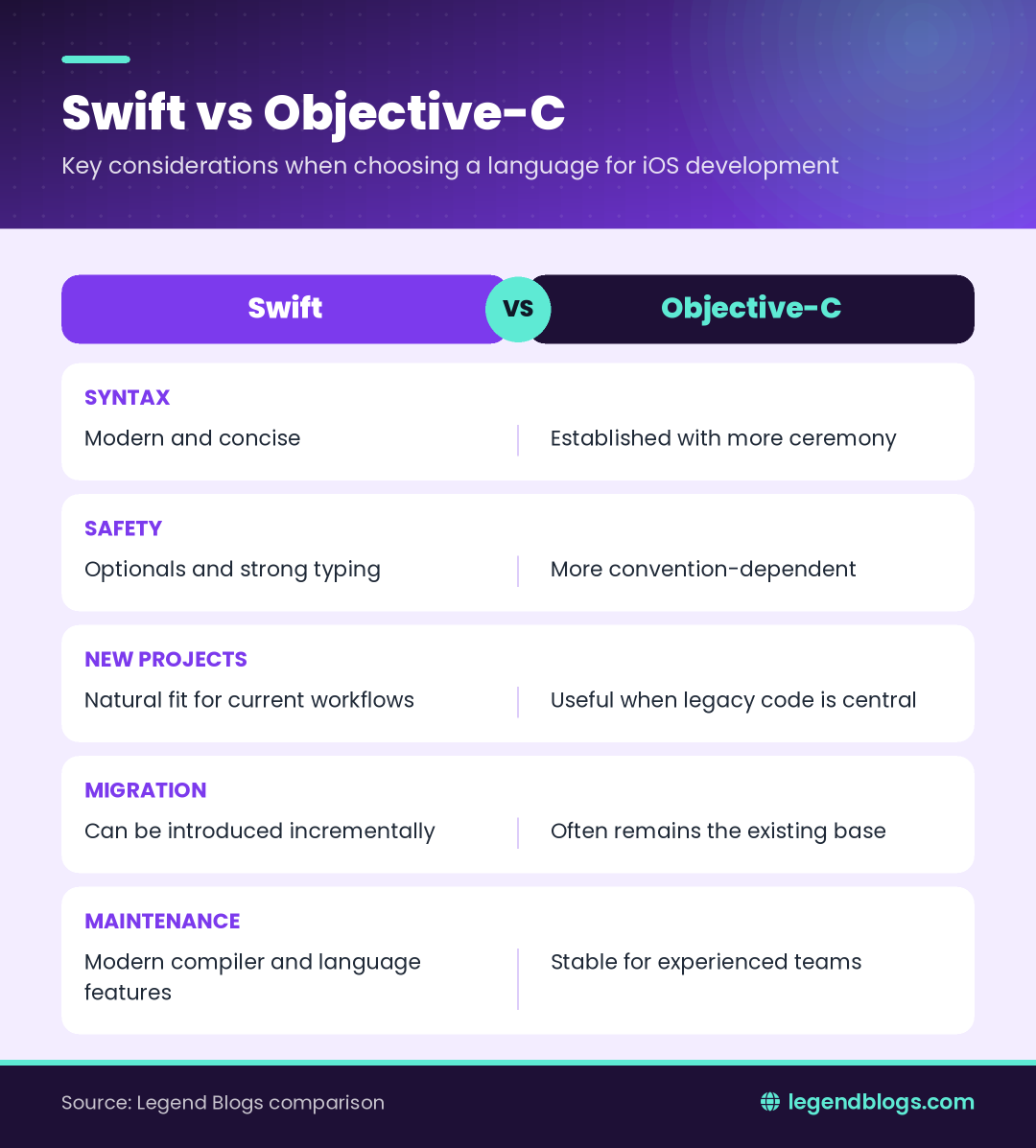
Swift vs Objective-C comparison
| Area | Swift | Objective-C |
|---|---|---|
| Syntax | Modern and generally concise | Established syntax with more ceremony |
| Safety | Optionals and strong typing make uncertainty explicit | Safety depends more heavily on conventions and checks |
| New iOS features | Natural fit for SwiftUI and current Swift APIs | Can use many frameworks but may need interoperability layers |
| Legacy code | Can call compatible Objective-C declarations | Often already present in mature applications |
| Migration | Can be introduced incrementally | May remain the stable base during migration |
| Maintenance | Strong compiler support and modern language features | Familiar and stable for teams with existing expertise |
How to choose for your project
For a new application
Start with Swift when the team wants modern Apple language features, is building new screens, and can support the relevant toolchain. Establish naming, testing, concurrency, error-handling, and module conventions early so the project does not depend on individual preferences.
For an existing Objective-C application
Measure before migrating. Identify the feature that is changing next, estimate the interoperability work, and decide how the result will be tested. A small successful migration can establish a pattern for later work without forcing a full rewrite.
FAQ
Is Swift better than Objective-C for new iOS apps?
Swift is often a strong default for a new iOS application because it provides modern syntax, type-safety features, and direct access to current Apple development workflows. The final decision should also consider team skills and dependencies.
Can Swift and Objective-C be used in the same project?
Yes. Compatible Swift and Objective-C code can coexist through the interoperability mechanisms supported by Xcode. Keep the boundary small and test both languages after changes.
Is Objective-C still used for iOS development?
Yes. It remains present in mature applications, legacy frameworks, and projects with existing Objective-C expertise. Its continued use does not prevent a team from introducing Swift incrementally.
Does Swift make iOS apps faster?
Language choice alone does not guarantee a faster app. Performance depends on algorithms, data access, rendering, concurrency, memory use, and measurement on the target devices. Profile the actual bottleneck before choosing a rewrite for performance reasons.
Should an existing Objective-C app be rewritten in Swift?
Usually, a complete rewrite should not be the first option. Compare its expected benefits with migration risk, testing cost, product deadlines, and the value of changing the specific code that causes problems.
Conclusion
The Swift vs Objective-C decision depends on the project rather than a single slogan. Swift is attractive for new iOS development because its syntax, safety features, tooling, and interoperability support modern workflows.
Objective-C remains valuable in established applications and integrations. Choose Swift for new work when it fits the team and platform, and use a measured, incremental migration strategy when improving an existing Objective-C codebase.







Write a comment