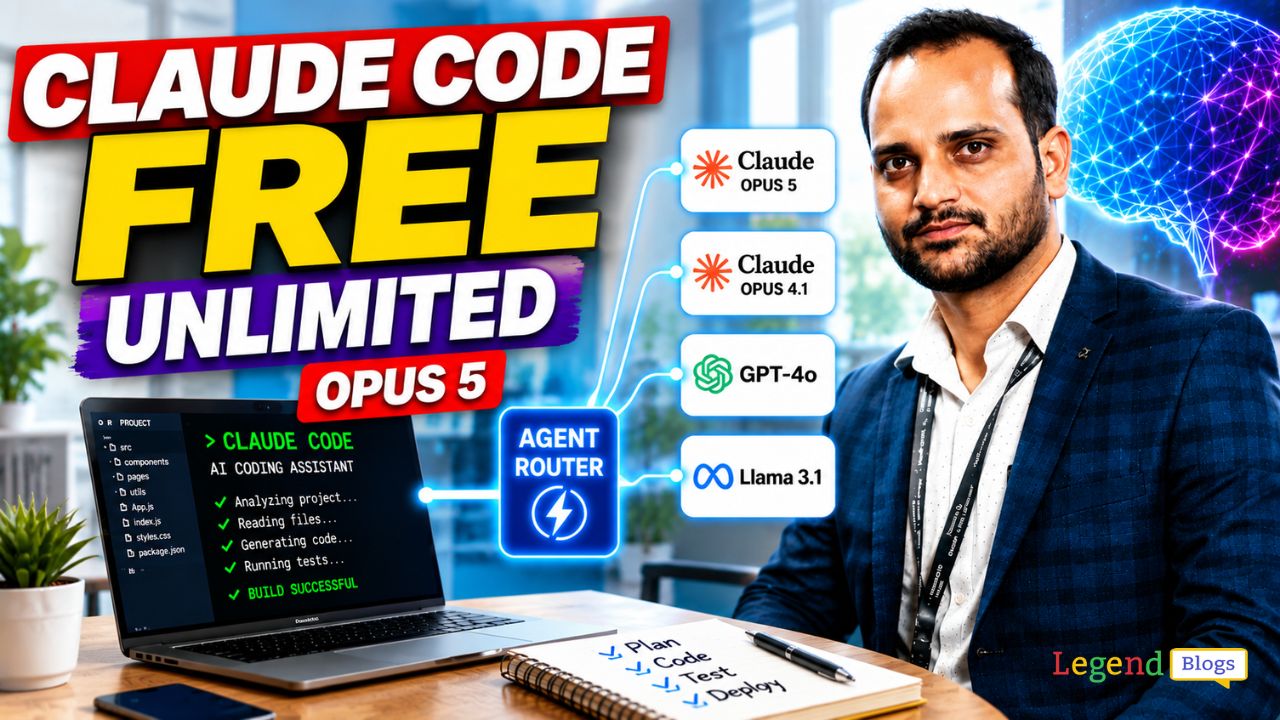
If you want to use Claude Code for AI-powered programming without immediately committing to another expensive subscription, the setup demonstrated in the offers an interesting alternative: connecting Claude Code to Agent Router and using its available credits to access supported AI models.
The video focuses on configuring Claude Code to work through Agent Router, obtaining available promotional credits, selecting models such as Claude Opus 4.8 and Opus 5, and then putting the setup to work on an actual coding project. The important distinction is that "free" in this context refers to promotional or account credits—not unlimited free Claude access from Anthropic itself. Credit amounts, eligibility and model availability can change.
Claude Code itself is Anthropic's command-line coding agent. It can inspect a project, edit files, execute commands and continue coding tasks from the terminal. Anthropic's documentation also supports configuring Claude Code through gateway or proxy layers, including custom API endpoints and model selection.
What Makes This Claude Code Setup Interesting?
AI coding assistants have changed considerably. Instead of asking an AI to generate one small function at a time, tools such as Claude Code can work with an entire software project.
That makes the underlying model important.
A capable model can understand relationships between files, reason about implementation decisions, identify bugs, modify existing code and iterate after seeing the results of terminal commands.
The challenge is cost.
Powerful reasoning models can become expensive when they are used continuously for development. This is why the Agent Router approach shown in the video is interesting: instead of connecting Claude Code directly to the standard Anthropic API, the developer configures it to communicate through another API gateway.
Anthropic itself documents the broader concept of LLM gateways for Claude Code. A gateway can provide centralized authentication, model routing, usage tracking, cost controls and other infrastructure features.
Claude Code Is More Than a Chatbot
The biggest advantage of Claude Code is that it operates inside a development environment.
Rather than copying code into a browser, asking for a response, and manually pasting the result into your project, Claude Code can interact with project files and terminal workflows.
For example, a developer can ask it to:
- Examine the existing project structure
- Explain unfamiliar code
- Create or modify files
- Fix bugs
- Refactor components
- Run commands
- Investigate errors
- Implement features
- Review changes
- Continue an existing coding session
Anthropic's CLI documentation includes interactive usage, non-interactive prompts, session continuation, model selection and other developer-oriented commands.
What Is Agent Router?
Agent Router acts as an intermediary between Claude Code and the model service.
The basic architecture is straightforward:
Your computer → Claude Code → Agent Router → AI model
Instead of Claude Code communicating directly with the standard Anthropic endpoint, the configuration points it toward Agent Router's endpoint.
The Agent Router documentation shows Claude Code being configured with the ANTHROPIC_BASE_URL environment variable, together with authentication variables containing the user's Agent Router token.
This is an important concept because Claude Code is not necessarily limited to one fixed connection method. Anthropic's own gateway documentation demonstrates that Claude Code can work with intermediary gateways and custom endpoints.
Why Use a Gateway?
There are several potential reasons.
The first is access. A gateway may provide access to models or promotional credits under its own pricing and eligibility rules.
The second is flexibility. Gateways can potentially route requests between different models or providers.
The third is cost management. Depending on the service, developers can monitor usage and manage spending through the gateway.
However, there is an important trade-off: you are introducing another service between your coding environment and the model provider. That means you should understand its terms, privacy practices, authentication requirements and current pricing before using it for sensitive projects.
How the Claude Code and Agent Router Setup Works
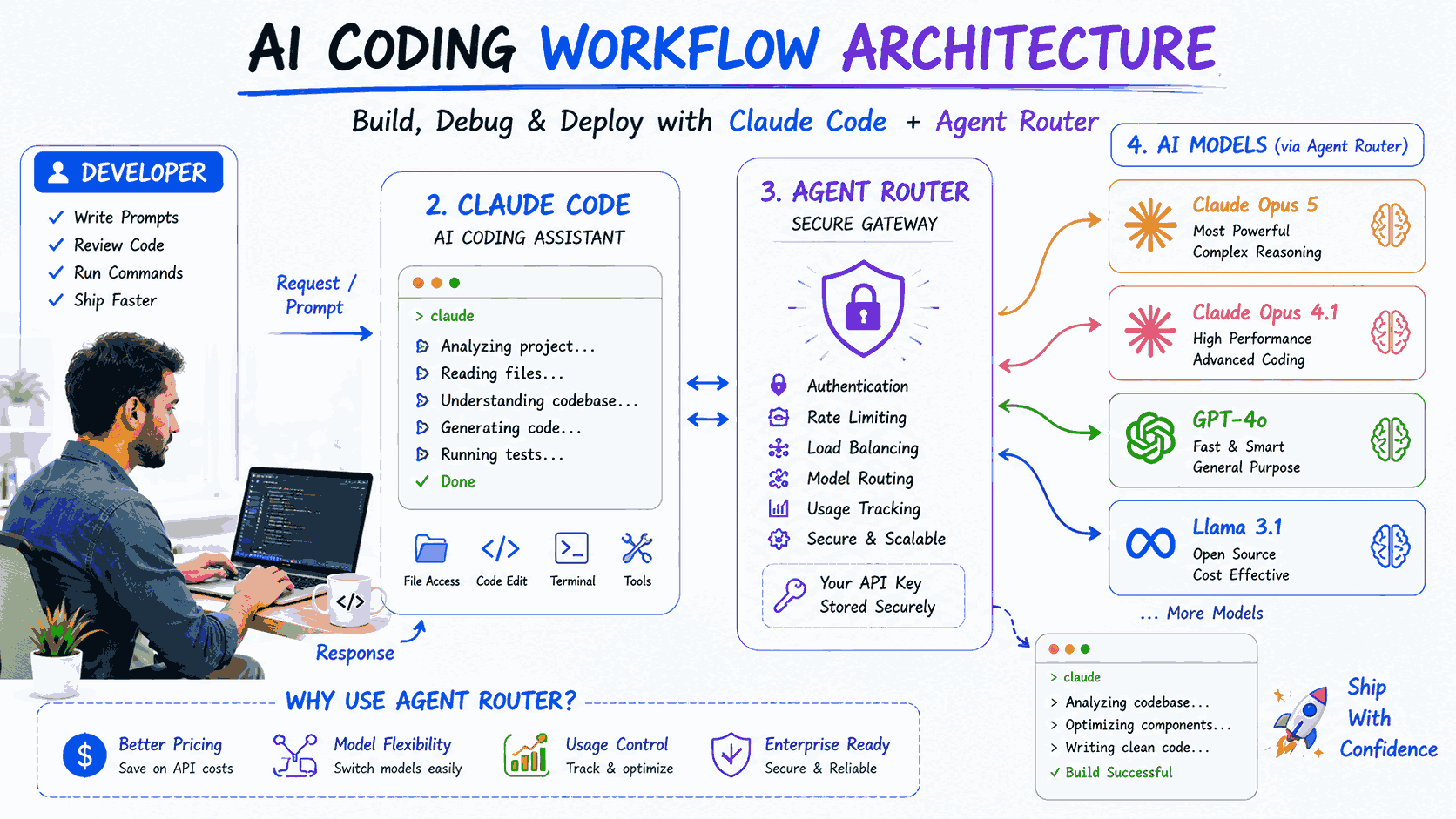
The process shown in the video can be understood as a sequence of four major stages.
Create an Agent Router Account
The first step is to visit the Agent Router service and create or access an account.
Promotional credit offers are particularly relevant to this setup. However, these offers are not permanent guarantees. Current promotional amounts, eligibility requirements and expiration rules should always be checked directly on the service before relying on them.
Some current third-party documentation and community reports describe promotional credits for eligible users, but these figures can change over time.
Generate an API Token
Once the account is ready, the next step is generating an API token.
The token effectively acts as the credential Claude Code uses when communicating with the Agent Router API.
This credential should be treated like a password.
Never publish it in a GitHub repository, screenshot, blog post, public .env file or chat conversation. If you accidentally expose it, revoke it and generate a replacement.
The Agent Router setup documentation identifies the API token as the credential used alongside the custom Anthropic base URL.
Configure the Endpoint
The central configuration step is changing the endpoint Claude Code uses.
Agent Router's published documentation shows the following environment variables being used:
ANTHROPIC_BASE_URL— points Claude Code toward the Agent Router endpoint.ANTHROPIC_AUTH_TOKEN— supplies the Agent Router authentication token.ANTHROPIC_API_KEY— can also be configured with the token.
The exact commands differ between macOS/Linux shells and Windows PowerShell.
This configuration works because Claude Code supports configurable authentication and gateway-style connections. Anthropic's documentation specifically describes ANTHROPIC_BASE_URL as a mechanism for connecting Claude Code to an LLM gateway.
Launch Claude Code
After configuring the environment variables, the next step is simply launching Claude Code from the project directory.
The normal workflow remains familiar:
- Open your terminal.
- Navigate to the project.
- Start Claude Code.
- Give it a coding task.
- Review what it proposes or changes.
- Allow it to continue working as appropriate.
Anthropic documents claude as the standard command for starting an interactive Claude Code session.
Choosing the Right Claude Model
One of the most interesting aspects of the video is model selection.
Different models can have different strengths. A powerful model may be useful for architectural decisions, complicated debugging and larger coding tasks, while a faster or less expensive model may be preferable for straightforward edits.
Claude Code supports model selection through the --model option, and the CLI documentation describes aliases such as sonnet and opus as well as full model identifiers.
The video specifically focuses on newer Opus models, including Opus 4.8 and Opus 5, through the Agent Router setup.
The practical lesson is broader than any individual model name: don't automatically use the most powerful model for every task.
For example:
| Task | Sensible approach |
|---|---|
| Simple text or CSS change | Faster model |
| Small bug fix | Mid-tier model |
| Complex debugging | Strong reasoning model |
| Architecture planning | Strong reasoning model |
| Large refactoring | Strong model + careful review |
| Routine repetitive work | Cost-efficient model |
The optimal choice depends on the model availability and pricing offered by the gateway at the time you use it.
Testing Claude Code on a Real Project
A major strength of the video concept is that it doesn't stop after configuration.
The real test is whether Claude Code can actually help build something.
Once the connection is working, a developer can open an existing project and give Claude Code a concrete task.
For example:
"Analyze this project, identify the main components, and explain how the application is structured."
After Claude understands the codebase, the developer can move to a practical implementation request.
A good workflow is incremental:
Understand → Plan → Implement → Test → Review → Improve
This is safer than immediately asking an AI agent to rewrite an entire application.
Start With a Small Task
If you have just configured Claude Code through a new gateway, don't begin with a production migration.
Start with something reversible.
Ask the agent to inspect the project. Then ask it to make a small change. Run the application and inspect the result.
This gives you an opportunity to verify that:
- Authentication works
- The model responds correctly
- Tool calls behave as expected
- File modifications are sensible
- Your project remains intact
- Usage is being deducted as expected
Only after confirming the setup should you move to larger tasks.
Why the "Free" Claim Needs Some Context
The most important clarification when discussing this setup is the word free.
It would be misleading to interpret the video as meaning that Anthropic has made unlimited Claude Code usage permanently free.
That is not what the setup demonstrates.
Instead, the approach uses promotional credits supplied by the intermediary service. Once those credits are exhausted, normal service rules may apply.
This distinction matters because promotional programs can change.
A service might offer a certain amount of introductory credit today and modify the offer tomorrow. Eligibility may also depend on account age, region, sign-in method or other criteria.
Therefore, anyone following this tutorial should verify the current offer before signing up.
Is Agent Router Safe to Use?
This is one area where users should slow down.
Routing your coding requests through a third-party service means that the service sits in the communication path.
For ordinary experimentation, that may be acceptable.
For confidential software, proprietary source code, private credentials or regulated information, the decision deserves much more scrutiny.
Before using a third-party gateway for serious development, check:
- Privacy policy
- Data retention policy
- Security documentation
- Terms of service
- Authentication process
- Model provider relationships
- Credit expiration rules
- Pricing after promotional credits
- Logging practices
Anthropic's documentation itself warns that third-party gateway products can have their own security and functionality considerations. Its LLM gateway documentation uses LiteLLM as an example and explicitly notes that Anthropic does not endorse or audit that third-party proxy.
The same general principle should be applied to any intermediary.
Common Mistakes to Avoid
Exposing Your API Token
This is probably the easiest mistake to prevent.
Don't put your token directly into source code.
Use environment variables or an appropriate secret-management solution.
Assuming Credits Are Unlimited
Promotional credits are finite.
Monitor your balance and understand how requests consume credits before using an expensive model for large tasks.
Blindly Accepting AI Changes
Claude Code can make substantial modifications to a project.
Always review important changes.
AI-generated code can introduce bugs, security problems, unnecessary complexity or unintended behavior.
Using the Most Expensive Model for Everything
A strong model is useful, but not every task requires maximum reasoning capability.
Using a cheaper or faster model for routine work can stretch your available credits considerably.
Giving an Agent Too Much Freedom
Claude Code has powerful capabilities, including executing terminal commands. Anthropic's CLI documentation includes permission-related options and specifically warns that --dangerously-skip-permissions should be used with caution.
For unfamiliar projects, permissions and changes should be handled carefully.
Who Should Try This Setup?
This approach is particularly interesting for:
- Developers experimenting with AI coding agents
- Students learning AI-assisted programming
- Indie developers building prototypes
- Vibe-coding enthusiasts
- Developers comparing different AI models
- Engineers who want to experiment before committing to a subscription
It may be less appropriate for teams that require strict enterprise controls unless the gateway has been properly evaluated and approved.
The Bigger Lesson for AI Developers
The most interesting takeaway from this video isn't simply "how to get Claude Code free."
It is the changing architecture of AI development tools.
Developers increasingly have several layers:
Coding interface → agent → gateway/router → model provider
This separation creates new possibilities.
A coding agent doesn't necessarily have to be permanently tied to one model. Gateways can provide routing, authentication, usage tracking and potentially access to different providers.
Anthropic's own documentation describes model routing as one of the functions that an LLM gateway can provide.
That means the future AI development workflow may look less like choosing one AI subscription and more like assembling a flexible development stack.
Should You Try Claude Code Through Agent Router?
If you're curious about AI-assisted programming, the setup is worth experimenting with—particularly when promotional credits make the initial cost low.
But approach it as an experiment rather than a promise of unlimited free AI coding.
First verify the current Agent Router offer. Then create your token, configure Claude Code, test a small project and monitor your usage.
Most importantly, understand where your code is being sent and who operates each part of the infrastructure.
The real value of Claude Code isn't simply access to a powerful model. It is the ability to combine natural-language instructions, codebase understanding, terminal interaction and iterative development into one workflow.
If Agent Router can reduce the initial barrier to experimenting with that workflow, it can be an attractive option for developers who want to explore what modern AI coding agents can actually do.
FAQ
Can Claude Code be used without an Anthropic subscription?
Claude Code can be configured to communicate through supported gateways and API infrastructure. Anthropic documents LLM gateway configurations for Claude Code, but the availability and cost of a particular third-party gateway are separate from Anthropic's own subscription plans.
Is Claude Code completely free through Agent Router?
Not necessarily. The setup discussed in the video relies on promotional or introductory credits. These credits can have limits and eligibility requirements, so they should not be interpreted as permanently unlimited free usage.
Does Agent Router provide Claude Opus models?
The referenced video specifically demonstrates using Opus models through Agent Router. Model availability can change, so users should check the current Agent Router model list before configuring their setup.
How do I select a model in Claude Code?
Claude Code supports model selection through its CLI. Anthropic documents the --model option and model aliases such as sonnet and opus.
Should I use my main API token everywhere?
No. API credentials should be treated as sensitive secrets. Keep them outside public repositories and avoid sharing them in screenshots, tutorials or chat messages.
Is a third-party gateway suitable for confidential code?
That depends on the gateway's security, privacy and retention policies. For sensitive projects, review those policies carefully before sending proprietary source code through an intermediary.
Can Claude Code build an entire website?
Claude Code can work on multi-file software projects and perform development tasks, but it should still be treated as an AI development assistant rather than an infallible autonomous programmer. Complex projects require human review, testing and security checks.
Conclusion
The Article demonstrates an increasingly popular idea in AI-assisted development: use a coding agent such as Claude Code while connecting it to an alternative model gateway such as Agent Router.
The setup can make experimentation more accessible when promotional credits are available, and it provides an opportunity to explore powerful AI coding models without immediately committing to another paid plan.
But the smartest way to approach the method is with realistic expectations. "Free" means promotional credit, not unlimited access. Model availability can change. Third-party services introduce additional privacy and security considerations.
Used carefully, however, the workflow can be a useful way to experiment with modern agentic coding: describe the problem, let the agent inspect the project, make controlled changes, run tests, review the results and iterate.
That workflow—not simply the promotional credits—is the real reason this setup is worth understanding.





Write a comment