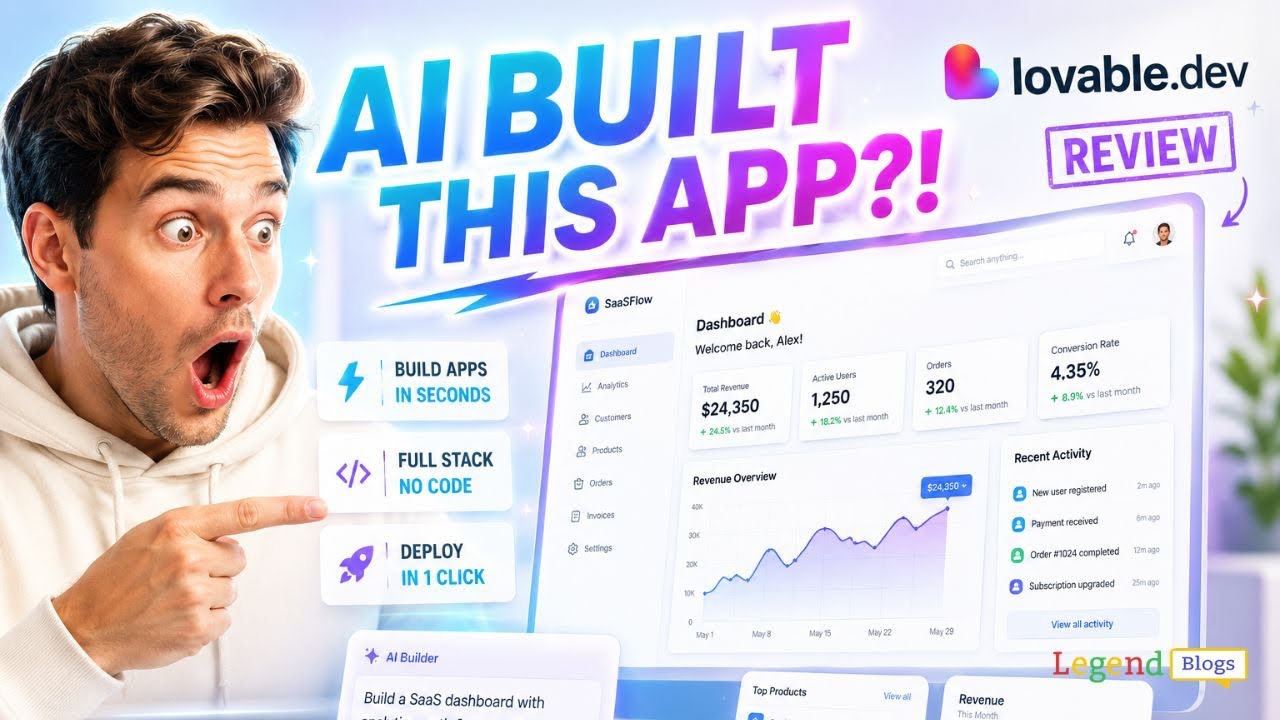
You no longer need a full development team to turn an idea into a working app. That’s the promise platforms like Lovable.dev are making right now.
And honestly? After testing dozens of AI coding tools, Lovable feels different.
It doesn’t just generate random UI screens. It actually behaves like an AI product engineer. You describe your idea in plain English, and it starts building full-stack applications with surprising speed.
For founders, freelancers, marketers, indie hackers, and even non-technical creators, this sounds almost unreal. But does Lovable actually deliver on the hype?
This detailed Lovable.dev review breaks down everything you need to know before using it.
What Is Lovable.dev?
Lovable.dev is an AI-powered full-stack app builder designed to help users create web applications using natural language prompts.
Instead of manually coding every component, users simply describe what they want. The platform then generates:
- Frontend UI
- Backend logic
- Database structure
- Authentication systems
- API integrations
- Deployment-ready applications
Lovable markets itself as “The AI Fullstack Engineer,” and based on user feedback, it’s rapidly becoming one of the most popular vibe-coding platforms available today.
Why Lovable.dev Is Getting So Popular
The biggest reason behind Lovable’s growth is simple:
Speed.
Traditional development can take weeks or months. Lovable can generate usable prototypes in minutes.
Many users praise the platform for helping them launch MVPs, landing pages, and SaaS demos extremely fast.
1. AI-Powered Full-Stack Development
Most no-code tools focus only on design.
Lovable goes further by generating:
- Backend functionality
- Authentication
- Database integration
- API workflows
- Hosting configuration
That makes it more powerful than many traditional website builders.
2. Beginner-Friendly Experience
You don’t need advanced coding knowledge.
The platform uses conversational prompts. You simply explain what you want.
For example:
“Build a SaaS dashboard with user login, Stripe payments, and analytics.”
Lovable attempts to generate the entire structure automatically.
This simplicity is one reason non-developers are adopting it quickly.
3. Fast MVP Creation
If you are validating startup ideas, Lovable becomes extremely useful.
You can:
- Build prototypes quickly
- Test business ideas
- Share demos with investors
- Launch landing pages
- Create internal tools
Instead of spending months building version one, you can validate ideas almost instantly.
Lovable.dev Features Review
Here’s where Lovable actually shines.
1. Prompt-to-App Generation
This is the core feature.
You type a request in plain English, and the AI creates a working application structure.
The generated apps often include:
- Responsive layouts
- Functional navigation
- Authentication pages
- Dashboard systems
- Forms and CRUD operations
Compared to older no-code builders, the output feels more modern and production-ready.
2. GitHub Integration
One major advantage is ownership.
Lovable lets users connect directly with GitHub, giving developers access to their generated codebase.
This reduces the fear of vendor lock-in.
You are not trapped inside a closed platform forever.
3. Supabase Integration
Lovable heavily integrates with Supabase for backend functionality.
This enables:
- Databases
- Authentication
- Storage
- APIs
- Real-time features
For startups, this combination can dramatically reduce development time.
4. One-Click Deployment
Publishing apps is surprisingly easy.
Users can deploy projects directly without complicated DevOps workflows.
This makes Lovable attractive for creators who want speed over infrastructure management.
5. Visual Editing
Unlike pure AI coding tools, Lovable also supports visual editing.
You can tweak layouts, modify text, and adjust styling without manually editing every line of code.
Lovable.dev User Experience
The platform’s UI is clean and modern.
Most users report that onboarding feels intuitive.
Even beginners can understand the workflow quickly.
The AI chat interface feels more natural than traditional app builders because it mimics a conversation instead of forcing users through endless menus.
One Reddit user mentioned that Lovable even asked clarifying questions while building the app, making the process feel collaborative rather than robotic.
That small detail creates a much smarter user experience.
Lovable.dev Pricing Review
Lovable offers multiple pricing tiers.
Based on recent public pricing data:
| Plan | Price | Features |
|---|---|---|
| Free | Free | Limited prompts and projects |
| Starter/Pro | Around $20–25/month | More prompts and private projects |
| Launch | Around $50/month | Higher usage limits |
| Scale/Business | Around $100/month | Team and advanced features |
The pricing itself isn’t outrageous.
However, there’s one issue many users mention repeatedly:
Credits.
Heavy projects consume credits quickly. Some users feel the pricing becomes expensive once applications grow larger.
If you build complex SaaS products daily, costs may rise faster than expected.
What Lovable.dev Does Better Than Competitors
The AI app builder market is crowded now.
Tools like Bolt.new, Replit Agent, v0, Cursor, and Base44 all compete aggressively.
But Lovable has a few clear strengths.
1. Better UI Generation
The frontend quality is impressive.
Generated layouts usually look modern instead of outdated template designs.
That matters because ugly MVPs kill trust instantly.
2. Faster Idea-to-Prototype Workflow
Lovable excels at rapid prototyping.
You can move from idea to working interface within hours instead of weeks.
This is especially valuable for:
- Startup founders
- Agencies
- Freelancers
- Product designers
- Solo creators
3. Multi-Modal Inputs
Lovable supports more than just text prompts.
According to recent reports, it also supports Figma imports, images, and voice-based workflows.
That flexibility makes it appealing for design-heavy projects.
The Downsides of Lovable.dev
No AI builder is perfect.
Lovable still has important limitations.
1. Complex Apps Can Break
Several users report that larger applications become unstable over time.
Problems may include:
- Broken logic
- Unexpected code changes
- AI loops
- Backend inconsistencies
This means developers still need to review generated code carefully.
2. Credit System Can Feel Restrictive
If you iterate heavily, credits disappear quickly.
This becomes frustrating during experimentation or debugging.
3. Not Ideal for Enterprise-Scale Systems
Lovable works best for:
- MVPs
- Startup prototypes
- Internal tools
- SaaS validation
- Landing pages
For highly complex enterprise software, traditional engineering still wins.
4. SEO Limitations
One Reddit user complained that SEO performance and indexing were problematic for generated projects.
This won’t affect everyone, but it’s worth considering if organic traffic matters heavily to your business.
Who Should Use Lovable.dev?
Lovable is best for:
Startup Founders
You can validate ideas before hiring developers.
Freelancers and Agencies
Rapid client prototyping becomes much faster.
Non-Technical Entrepreneurs
You can build products without learning advanced programming.
Product Designers
The visual-first workflow helps turn mockups into real products quickly.
Indie Hackers
Perfect for launching experiments rapidly.
Who Should Avoid It?
Lovable may not be ideal if:
- You need enterprise-grade architecture
- You require deep backend customization
- You want complete engineering control
- Your product depends on highly optimized performance
- You dislike usage-based pricing
In those cases, tools like Cursor + Claude or traditional development workflows may be better long-term.
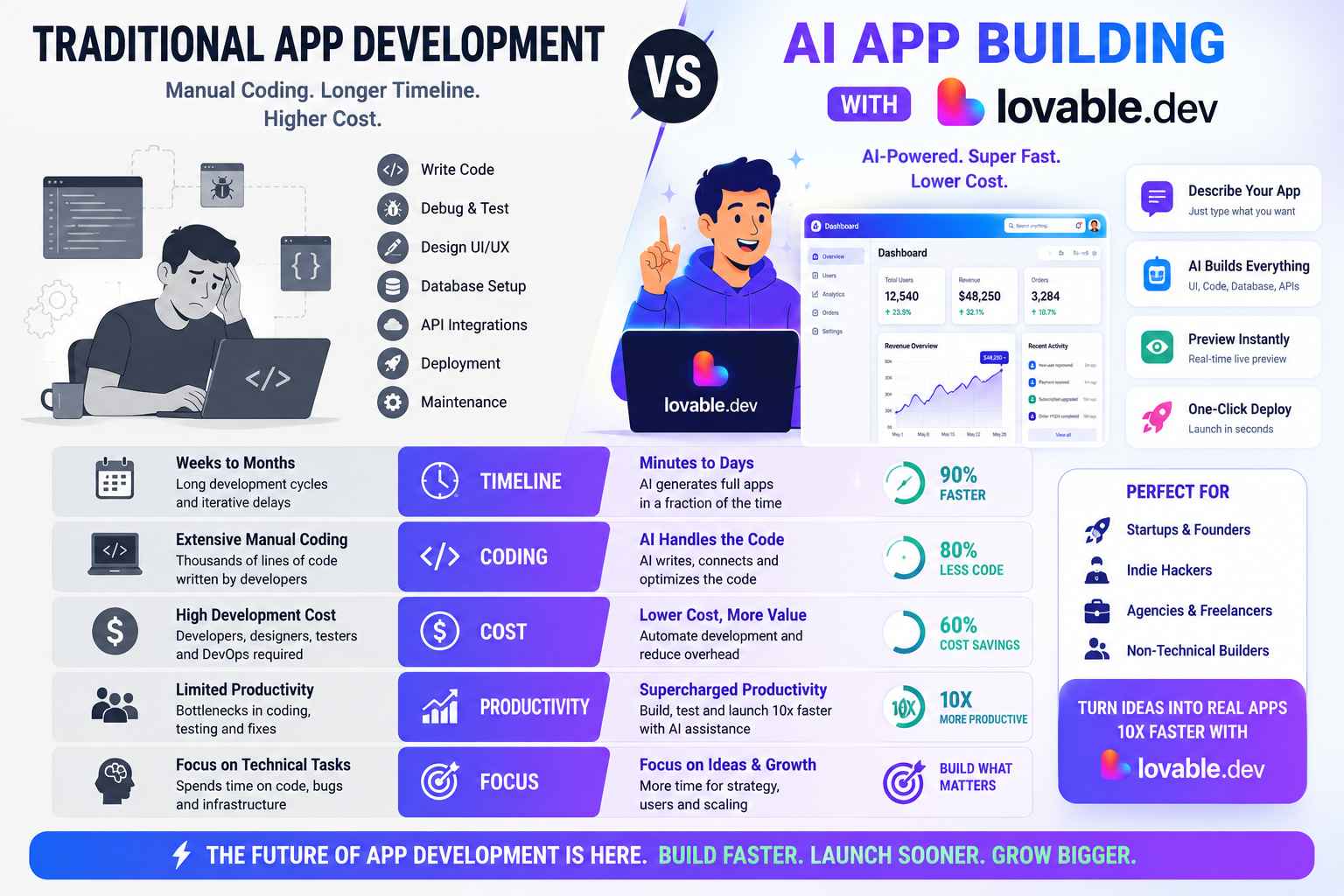
Is Lovable.dev Worth It?
For most creators in 2026, yes.
Lovable dramatically lowers the barrier to building software.
It’s not magic. It won’t replace senior developers completely.
But it absolutely accelerates product creation.
That alone makes it valuable.
The platform feels especially powerful for people stuck between having an idea and actually launching something.
Instead of waiting months to build an MVP, you can start testing immediately.
And in today’s startup world, speed matters more than perfection.
Final Verdict
is one of the most impressive AI app builders currently available.
Its combination of:
- AI-powered full-stack generation
- Fast prototyping
- GitHub integration
- Modern UI output
- Beginner-friendly workflows
makes it a serious productivity tool for modern creators.
Yes, there are limitations.
Credits can become expensive. Complex apps still need human oversight. And enterprise-level reliability remains a challenge.
But for startups, solo founders, creators, and fast-moving teams, Lovable can save hundreds of hours of development time.
If you’ve been waiting for the “idea to app” process to become easier, this might be the tool that finally makes it happen.
FAQ
Is Lovable.dev good for beginners?
Yes. Lovable is designed for non-technical users and beginners. The conversational AI workflow makes app creation far easier than traditional coding.
Does Lovable.dev generate backend code?
Yes. It can generate backend logic, databases, authentication systems, and API integrations.
Can I export code from Lovable.dev?
Yes. GitHub integration allows users to access and manage generated code.
Is Lovable.dev free?
It has a free plan, but usage limits apply. Advanced features require paid subscriptions.
Is Lovable.dev better than Bolt or Replit?
It depends on your use case. Lovable is stronger for rapid UI-focused MVP generation, while tools like Cursor or Replit may offer more developer control.





Write a comment