
It's very simple to find the minimum value of an array using foreach loop. Create an array with some numeric value.
Now create a temporary variable $temp in which stored array’s first index’s value i.e 45.
$arr=array(45,78,485,58,5,45,47);
$temp=$arr[0];
foreach($arr as $x)
{
	if($x<$temp)
	{
		$temp=$x;
	}
}
echo "Minimum value of array = ".$temp;
Output:
Minimum value of array = 5What Is the Minimum Value in a PHP Array?
Define the task
Finding the minimum means identifying the lowest comparable value in a collection. A numeric array may contain prices, scores, measurements, or IDs. The correct method depends on whether the values are truly numeric, whether the array can be empty, and whether you also need the key.
Check the input first
Do not assume every array contains valid numbers. Data received from a form, file, or API may include empty strings, labels, or numeric text. Decide whether invalid entries should be rejected, ignored, or reported before calculating a result.
Use the PHP min() Function
Simple numeric arrays
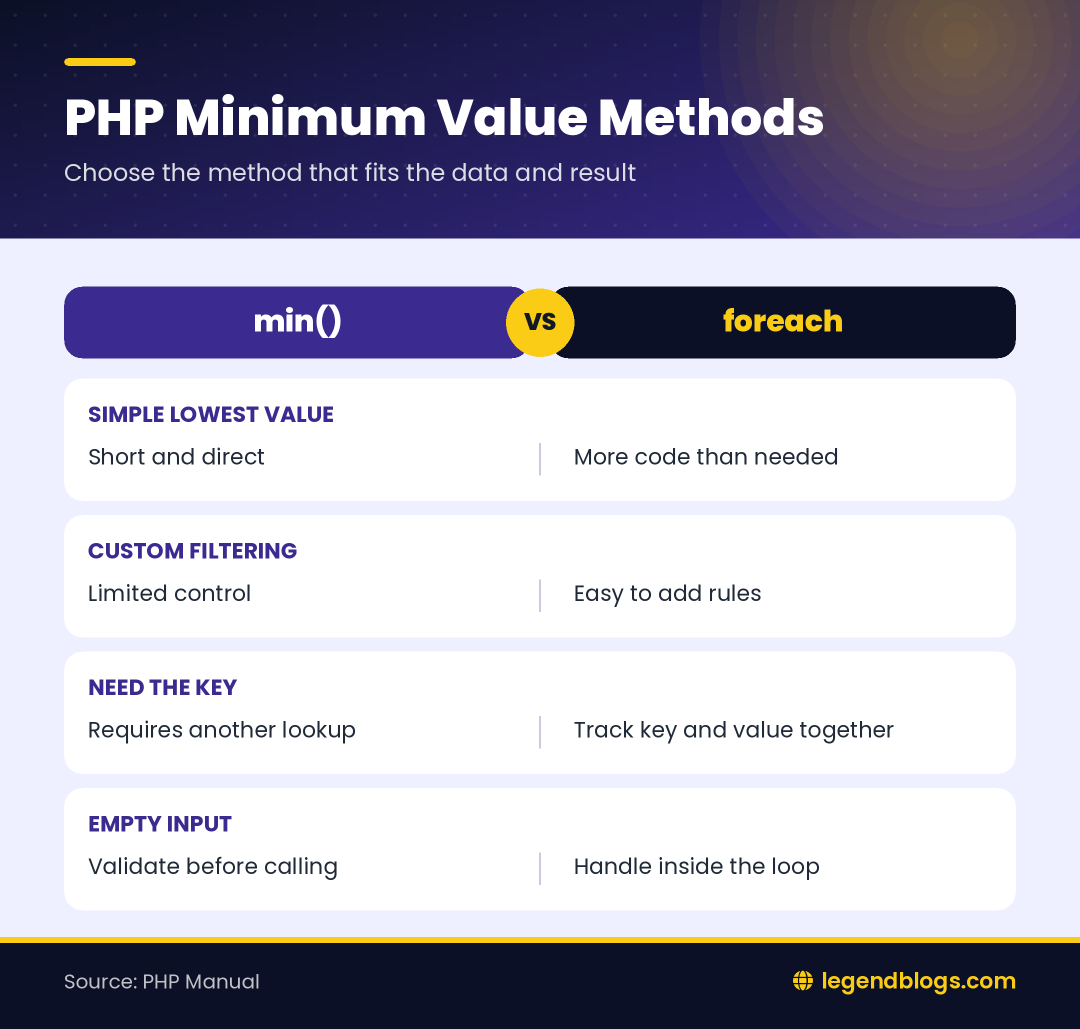
For a normal list of comparable values, PHP’s min() function is the shortest solution. Pass the array to min($values), store the returned value, and display it. This is clearer than sorting the complete array when you need only the smallest item.
Know the empty-array behavior
Check that the array is not empty before calling min(). Current PHP versions throw a ValueError for an empty array. A clear validation branch gives the user or calling code a useful response instead of an unexpected failure.
Use a foreach Loop
Preserve the manual approach
The original example starts with the first array item, visits each value, and replaces the temporary minimum when a lower value is found. This method is useful when you need custom rules, logging, filtering, or a result that includes additional information.
Why the first item is a good starting point
Starting with the first actual value works with positive numbers, zero, and negative numbers. Starting with zero can be wrong when all valid values are positive or when the array contains only negative values. Starting with an arbitrary large constant has a similar weakness.
Handle Negative Numbers and Zero
Test realistic ranges
Try values such as -12, 0, 7, and 3. The minimum should be -12. A correct loop compares actual values rather than assuming the data is always positive.
Do not use false as a fallback
A fallback value should not be confused with a valid numeric result. If zero is a valid minimum, returning zero for an empty array makes it impossible to tell whether the calculation succeeded. Use a separate success flag or return a clear error result.
Find the Minimum in an Associative Array
Compare the values
min() can compare the values of an associative array because PHP arrays are collections of values and keys. If you need a product or record associated with the minimum, preserve the key or use a loop that tracks both the current key and current value.
Keep labels with results
For example, a price list may use product names as keys. Finding the numeric minimum tells you the lowest price, but users may also need the product name. A manual loop or a search after calculating the minimum can provide both pieces of information.
Find the Key of the Minimum Value
Use array_search carefully
After finding the minimum, array_search($minimum, $values, true) can locate its key when the value types match. Strict comparison avoids treating a numeric value and a numeric string as identical accidentally.
Handle duplicate minimums
array_search returns the first matching key. If several records share the same lowest value, collect every matching key with a loop or use a filtering approach. Decide whether the application wants the first result, all results, or a tie message.
Validate Numeric Input
Separate numbers from text
Use is_numeric() when numeric strings are acceptable, then normalize them according to the application’s needs. Do not silently treat labels such as “unknown” as zero. Invalid data should be rejected or handled explicitly.
Be careful with mixed types
The PHP manual warns that comparisons between different types follow PHP’s comparison rules. A mixture of numbers, non-numeric strings, booleans, or null can produce a result that does not match the business meaning. Validate and normalize before calling min().
Compare min() and foreach
When min() is best
Use min() when you have a validated, non-empty collection and need only the lowest value. It communicates intent immediately and keeps a simple calculation short.
When foreach is best
Use foreach when you need the original key, a related record, custom filtering, validation messages, or several values from the same pass. The longer method can be more maintainable when the calculation is part of a business rule.
Common Mistakes
Sorting unnecessarily
Sorting an array changes its order or requires a copy, even though finding a minimum does not require ordering every item. Use min() or a single loop unless you actually need the sorted list.
Comparing strings as numbers
Numeric strings may be acceptable in some cases, but mixed strings can be compared in surprising ways. Normalize external input before calculation and use strict checks when locating the result.
Practical Examples
Prices and scores
A shop can find the lowest validated price, while a grading tool can find the lowest score. In both cases, an empty list needs a separate message because there is no meaningful minimum.
Measurements
For temperatures or distances, negative values and zero may be valid. Initialize a loop from the first real value and test boundary cases rather than assuming all measurements are positive.
Testing Checklist
- Test a normal list with several positive values.
- Test one item and an empty array.
- Test zero and negative numbers.
- Test duplicate minimum values.
- Test associative keys.
- Test numeric strings and invalid text.
- Confirm the result type is suitable for the next operation.
FAQ
How do I find the minimum value of an array in PHP?
For a validated non-empty numeric array, pass it to min($values). A foreach loop is better when you need custom conditions or the key associated with the result.
What function finds the smallest number in PHP?
The built-in min() function finds the lowest comparable value. Validate the input first and avoid mixing unrelated types.
How do I find the key of the minimum value?
Calculate the minimum, then use a strict array_search or track the key and value together in a foreach loop. Decide how duplicate minimums should be handled.
Does min() work with negative numbers?
Yes, when the input contains comparable numeric values. Test negative values explicitly and do not initialize a manual loop with zero.
What happens when the PHP array is empty?
Current PHP versions throw a ValueError when min() receives an empty array. Check count or empty before calculating and choose an appropriate fallback or error response.
Conclusion
The easiest way to find a PHP minimum array value is usually min(), but a foreach loop remains valuable when the calculation needs validation, keys, related records, or custom rules. The important part is to validate the collection and define empty and mixed-type behavior.
Start with a small test set containing positive, zero, negative, duplicate, and invalid values. Then choose the shortest method that still makes the result clear to the next developer.
Choosing a Reliable Implementation
Keep the calculation close to the data
Validate and calculate the minimum at the boundary where data enters the application. This prevents several later functions from making different assumptions about strings, null values, or empty collections.
Document the result
State whether the function returns a number, a numeric string, a key, or an error response. Clear result expectations make the minimum calculation easier to reuse in forms, reports, and database queries.
Final Review
Use min() for a simple validated list and foreach when the key, record, or business rule matters. Test both normal and exceptional inputs before using the result in later calculations.







Write a comment