Blogging is entering its most transformative era yet. In 2026, the landscape won’t just evolve — it will leap forward thanks to powerful technologies reshaping how content is created, published, discovered, and monetized. From artificial intelligence to immersive platforms, the next wave of innovation is redefining what a blog can be and how bloggers can succeed.
In this article, we’ll explore the most impactful tech trends set to transform blogging in 2026. Whether you’re a seasoned creator or just starting out, these trends will help you stay ahead, create better content, and grow your audience in a competitive digital world.
Blogging technology trends are most useful when treated as options to evaluate, not predictions that every publisher must follow. New features can make research, editing, accessibility, and measurement easier, but a tool only helps when it fits the audience, budget, and editorial standards. The practical approach is to test a small number of changes and keep the ones that improve a real reader outcome.
Separate usable tools from speculation
Ask what problem the technology solves
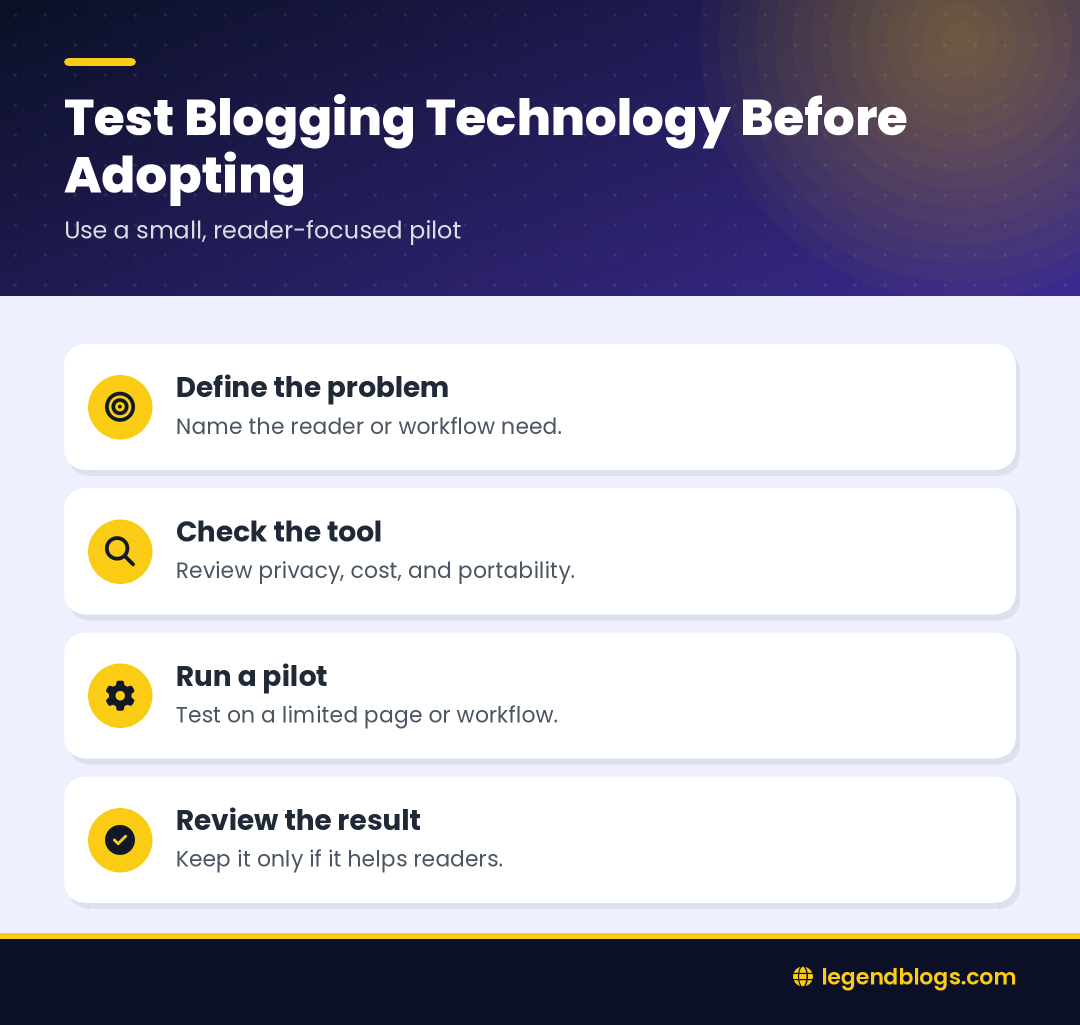
Before adopting a platform or feature, describe the problem in plain language. Is the publishing team spending too long preparing transcripts? Are readers struggling to find related guides? Is the site difficult to use on a phone? A specific problem makes it possible to compare tools against a baseline instead of buying technology because it sounds modern.

Classify ideas by maturity. An available feature can be tested in a limited workflow; an experimental feature needs a fallback; and a speculative possibility should not be presented as a settled 2026 reality. This distinction keeps planning honest and helps avoid building a business around assumptions that have not been validated.
Use an experiment with an exit point
Try a tool on one article or a short campaign. Define the time, cost, privacy checks, and quality measure in advance. Set a review date and decide what result would justify continuing, changing, or stopping. A small pilot reduces disruption and makes it easier to compare the result with the existing process.
Why 2026 Is a Turning Point for Blogging Technology
Blogging has always mirrored broader technological shifts — from early HTML pages to CMS platforms like WordPress, to social distribution on Facebook and Twitter. But the changes set for 2026 are not incremental; they are foundational.
These trends are powered by advances in AI, computing, connectivity, and user behavior shifts. Combined, they are ushering in an era where content is smarter, more interactive, more personalized, and more connected to emerging digital ecosystems like the metaverse.
Let’s break down the key tech trends that will redefine the future of blogging.
AI-Driven Content Creation and Optimization
1. AI-Powered Drafting and Ideation
AI writing tools are already helping bloggers streamline content creation in 2025, but in 2026 they will become integral writing partners. Advanced models will:
- Generate first drafts from brief prompts
- Suggest headlines optimized for clicks
- Predict trending topics based on real-time data
- Rewrite content for tone, voice, and audience relevance
The result? Bloggers will spend less time on repetitive writing tasks and more time on strategy and creativity.
Use AI assistance without losing editorial accountability
Assign suitable tasks and keep people responsible
AI can assist with brainstorming, outlining, transcription, rewriting for readability, or generating a first draft from notes. Editors still need to verify facts, identify missing viewpoints, remove unsupported claims, and ensure that the work reflects genuine expertise. Automation can make a draft arrive sooner; it cannot establish that the draft is accurate or useful.
Keep a record of sources and decisions for material that readers rely on. If an AI tool produces a citation, check that the source exists and supports the claim. Avoid passing private reader, customer, or unpublished business information into a service without checking its data terms and your own obligations.
Measure usefulness, not just speed
Saving time is valuable only if quality stays acceptable and the saved effort is used well. Compare editing corrections, reader questions, update frequency, and the task’s actual completion time. If AI makes an article faster but introduces repeated factual or tonal issues, the process may not be an improvement.
Likewise, search visibility cannot be guaranteed by a tool that adds keywords or generates metadata. Start with the reader’s question, answer it clearly, and make the page easy to navigate. Use search data as feedback rather than as a substitute for editorial judgment.
Improve analytics and content discovery carefully
Choose a small set of meaningful measures
A dashboard can report traffic, engagement, and conversions, but more metrics do not automatically produce better decisions. Decide what a successful visit means for a particular page: finding an answer, reading a related guide, subscribing, or completing another relevant action. Interpret trends in context, including seasonality, changes to distribution, and the difference between new and returning readers.
Recommendation features can help readers discover related material when the connections are genuinely useful. Avoid optimizing only for time on page or repeated clicks if that makes the experience harder to use. Give readers clear navigation, useful summaries, and an easy way to reach the source information they need.
Keep data collection proportionate
Personalization and measurement can involve sensitive data. Collect only what is needed, explain the purpose, and review retention and access practices. A simple recommendation based on the article a reader is viewing may be more appropriate than building a detailed profile that the site does not need.
2. Semantic SEO and Intent Optimization
Search engines are becoming smarter. In 2026, ranking well won’t be about keyword stuffing; it will be about semantic relevance and user intent.
AI tools will analyze search intent and restructure blog content for maximum visibility. This means:
- Keywords will be contextualized, not forced
- Content will answer questions users actually ask
- Technical SEO — like schema and entity optimization — will be automated
Bloggers who leverage AI for optimization will see huge gains in organic traffic and engagement.
Personalization at Scale
1. Adaptive Content Experiences
Static blog posts are giving way to adaptive content, personalized for each reader based on behavior, location, preferences, and past interactions.
For a practical blogging technology decision, separate features available to test from predictions about what may become widespread. Personalization, voice interfaces, immersive experiences, and token-based publishing are possibilities to evaluate against your readership, resources, and privacy obligations—not requirements every blog must adopt.
Imagine a blog that:
- Adjusts tone depending on reader preference
- Reorders sections based on what readers care about most
- Provides dynamic examples relevant to each reader’s industry
With personalization engines powered by machine learning, bloggers can deliver custom experiences at scale.
2. Smart Recommendation Engines
In 2026, blogs will compete less on individual page views and more on time spent in personalized ecosystems.
Recommendation engines, like those used by streaming platforms, will show:
- Related posts personalized to each reader
- Suggested reading paths
- Internal and external resources matched to user interests
This deepens engagement, improves retention, and boosts conversions.
Voice and Conversational Interfaces
1. Voice-First Blogging
Voice search and conversational UIs are mainstream. In 2026, readers will expect blogs to be voice-accessible:
- “Read this article to me”
- “Summarize today’s posts”
- “Find posts about influencer marketing”
Blogs optimized for voice commands and conversational interaction will reach a broader audience across devices like smart speakers, phones, and in-car systems.
2. Chatbot Assistants on Blogs
AI chat assistants embedded directly on blogs will become a standard feature. These bots will:
- Answer reader questions in real-time
- Provide summaries of posts
- Suggest related resources
- Collect feedback
This mimics a personal guide experience — increasing time on site and reader satisfaction.
Visual and Immersive Content
1. AR/VR Content Integration
The future of blogging is immersive. Augmented reality (AR) and virtual reality (VR) will allow creators to:
- Embed interactive visuals readers can explore
- Host VR tours, walkthroughs, and 3D galleries
- Create immersive storytelling experiences
For topics like travel, education, architecture, and product reviews, immersive content will be transformative.
2. Interactive Multimedia Posts
Static images and videos are being replaced with interactive elements:
- Clickable charts and graphs
- 3D models
- Interactive timelines
- Live polls and quizzes
These features increase engagement and make content more memorable.
Decentralized Platforms and Blockchain
1. Web3 Blogging Platforms
Blockchain technology enables new forms of content ownership and monetization:
- Immutable timestamping of content
- Token-based access and subscriptions
- Reward systems for contributors and curators
Web3 blogs will shift power away from centralized platforms and toward creators and communities.
2. NFT-Based Content Ownership
Non-fungible tokens (NFTs) will allow bloggers to:
- Sell unique content pieces
- Create collectible editions of posts, images, or series
- Build revenue streams tied to ownership and scarcity
This trend opens new business models for independent creators.
Real-Time Collaboration and Distributed Teams
1. Cloud-Based Editorial Workflows
Collaborative writing tools will become more powerful and integrated. In 2026:
- Multiple writers can co-author in real-time
- Editors and AI can provide live suggestions
- Version control and workflow automation will be seamless
Distributed teams will produce content faster without sacrificing quality.
2. Contributor Networks and Micro-Communities
Blogs will evolve into community hubs, with contributors from diverse backgrounds. Technology will make it easy to:
- Aggregate posts from experts
- Curate topic-specific sections
- Incentivize contributions via shared revenue systems
This creates richer content ecosystems and expands reach.
Automated Analytics and Predictive Insights
1. Predictive Analytics Tools
Understanding what content will perform well before publishing is a huge advantage. Predictive analytics tools will:
- Forecast traffic and engagement
- Suggest optimal posting times
- Identify trending topics before they peak
Bloggers can make data-driven decisions with confidence.
2. Unified Dashboards and AI Insights
Instead of juggling multiple analytics tools, bloggers will have unified dashboards where AI:
- Summarizes key metrics
- Detects anomalies
- Recommends actions to improve performance
This saves time and improves strategic planning.
Ethical AI and Responsible Content Practices
1. AI Transparency and Source Attribution
As AI writing becomes pervasive, ethical practices will matter more. In 2026:
- Blogs will disclose AI-assisted content
- Tools will provide source attribution
- Fact-checking integrations will ensure accuracy
This builds trust with audiences wary of misinformation.
2. Inclusive and Accessible Content
Tech will empower bloggers to create more inclusive content:
- Automated alt text for images
- Readability adjustments for various needs
- Multilingual support and instant translations
Accessible blogs will reach wider audiences and comply with evolving regulations.
Make accessibility and multimedia part of publishing
Improve the basic reading experience first
Before investing in immersive media, make sure the article is comfortable to read and operate. Use descriptive headings, meaningful link text, legible contrast, keyboard-friendly navigation, captions for video, and useful alternative text for informative images. Automated accessibility suggestions can help identify issues, but a human review is still needed for context and meaning.
Multimedia can clarify a process or comparison, but it should not conceal essential information from readers who cannot use that format. Provide text alternatives, captions, transcripts, or a clear written explanation when appropriate. Choose media because it improves comprehension, not because a format is fashionable.
Test on real devices and with readers
Preview a page on a phone and a larger screen. Check loading, layout, captions, interactive controls, and whether the main point remains understandable when images or animation are unavailable. Ask readers with different needs to try the page when possible; automated checks alone cannot tell you whether the content is genuinely easy to use.
Practical Tips for Bloggers in 2026
1. Embrace AI But Maintain Authenticity
Use AI for efficiency — ideation, drafting, optimization — but ensure content reflects your voice and expertise. Human perspective matters more than ever.
2. Invest in Interactive and Immersive Formats
Start experimenting with AR/VR elements and interactive visuals sooner rather than later. Early adopters will stand out.
3. Prioritize Personalization
Use tools that personalize content for readers. A tailored experience increases loyalty and return visits.
4. Focus on Ethical Practices
Be transparent about AI use, cite sources, and ensure accuracy. Trust is a long-term asset.
5. Explore New Monetization Models
From Web3 communities to NFTs and tokenized access, diversify revenue streams beyond traditional ads and affiliate marketing.
Evaluate monetization and platform dependence
Compare stability, control, and audience fit
Subscription, membership, sponsorship, affiliate, and digital-product models have different costs and obligations. A new payment or token-based service may sound attractive, but publishers should examine fees, audience familiarity, customer support, tax and refund responsibilities, and how easily readers can leave or retrieve their work.
For a related perspective on blogging as a passive income asset, see our guide to evaluating online income approaches; results depend on the business model and execution.
Do not assume a new model will outperform familiar channels. Run a modest test with clear expectations and explain the offer plainly. Keep backups of content and customer communications according to applicable requirements, and avoid making access depend on a technology your audience cannot reasonably use.
Protect ownership and portability
Review the platform’s terms before relying on it as the only place where drafts, subscriber information, or publication archives live. Export what you are entitled to keep, maintain secure backups, and understand what happens if a service changes its features or closes. Portability matters even when the tool works well today.
A practical adoption checklist for bloggers
- Name the reader or workflow problem the tool is meant to address.
- Check feature maturity, pricing, privacy terms, and export options.
- Run a limited test and compare it with your existing process.
- Review accuracy, accessibility, and reader feedback before expanding.
- Keep a human owner accountable for final editorial decisions.
- Stop or change course if the tool adds more risk or work than value.
This checklist applies to AI writing, analytics, personalization, multimedia, and monetization experiments alike. Tools should support a clear publishing purpose. The strongest long-term strategy is to build a useful, trustworthy publication that can adapt without depending on a single vendor or trend.
FAQ
What is the biggest tech trend impacting blogging in 2026?
The biggest trend is AI’s deep integration into content creation and optimization, enabling bloggers to produce high-quality, personalized content faster and more efficiently.
Will traditional blogging platforms remain relevant in 2026?
Yes. Platforms like WordPress and Medium will adapt by integrating AI tools, immersive media support, and personalization engines to stay competitive.
How will personalization change the reader experience?
Personalization will tailor content, layout, and recommendations based on individual behavior, increasing engagement and satisfaction.
Do bloggers need to learn AR/VR to stay relevant?
Basic understanding helps, but tools will make immersive content creation more accessible. Later, advanced skills will provide competitive advantages.
Are decentralized Web3 platforms the future of blogging?
Web3 offers compelling opportunities for ownership, monetization, and community building, but adoption will vary by niche and audience demographics.
Conclusion
Blogging in 2026 will not simply be an extension of today’s practices — it will be a reinvention. Technology is reshaping every stage of the blogging journey, from idea to creation, optimization, delivery, and monetization.
The blogs that thrive will be those that:
- Leverage AI intelligently and ethically
- Deliver personalized, interactive experiences
- Experiment with immersive media
- Embrace decentralized and innovative monetization
- Prioritize accessibility and trustworthiness
If you want to stay ahead in the blogging world, now is the moment to adopt these tech trends, experiment boldly, and adapt consistently.
2026 is not the end of blogging as we know it — it’s the beginning of a new, richer, more connected era.







Write a comment