This Cinepix AI review looks at the product as a marketing offer, not as a promise of traffic or income. Its promotional material describes a workflow for finding existing pages and creating contextual responses that may include affiliate links. That idea may sound quicker than building an audience from scratch, but a tool cannot guarantee that a placement is accepted, seen, or profitable.
Below, I separate what the offer claims from what a buyer should verify: the actual workflow, platform rules, costs, practical limitations, and alternatives. Because product details and launch terms can change, confirm the current sales page and checkout before making a decision.
Cinepix AI Review: What This Assessment Covers
Separate advertised features from verified outcomes
This Cinepix AI review evaluates the advertised workflow, the checks a buyer can make, and the risks that remain outside the software. It does not treat promotional claims as independent evidence of performance.
What Is Cinepix AI?
Its stated purpose and intended audience
Cinepix AI is marketed as an AI-assisted traffic and promotion tool. The public-facing description associated with the offer presents it as a way to identify pages that already receive search visibility and help create responses or promotional placements connected to those pages.
The offer appears aimed at affiliate marketers and other online promoters who want ways to expose offers to an audience without first building a large content site. That describes the intended use, not proof that the method will produce traffic or conversions for every buyer.
For readers comparing software offers, this Cinepix AI review focuses on practical buyer questions rather than assuming a tool's target audience will automatically benefit from it.
What a product description does—and does not—establish
A sales page can explain the vendor's intended workflow, list included functions, and describe an example use case. It does not independently establish how many visitors a buyer will get, whether third-party sites will accept a contribution, or whether those visitors will buy.
When assessing the product, distinguish between a software feature and an outcome. A keyword scanner or response generator may be a feature; actual placement, visibility, referral visits, and commissions depend on other people, platforms, the offer, and the marketer's execution.
How Cinepix AI Says Its Traffic Method Works
The advertised workflow
Based on the product's promotional description, the general sequence is to enter a keyword or topic, look for relevant pages or discussions, generate a suggested response, and then place a promotional link where the marketer believes it fits. The tool is presented as assisting with research and content preparation.
That description should not be confused with guaranteed or fully automated distribution. A suggestion is not the same as an approved post, a search ranking, or a visitor. The buyer still needs to inspect each opportunity and decide whether participating is appropriate.
That distinction is central to this Cinepix AI review: discovery and drafting may assist a process, while acceptance and audience response remain uncertain.
What still requires user action
Before using a suggested placement, a marketer should review the page, understand its purpose, and check the site's rules. A response that is irrelevant, misleading, repetitive, or primarily promotional can damage trust and may be removed or reported.
The user also remains responsible for checking that the linked offer is suitable, that claims are accurate, and that any required affiliate disclosure is clear. In practice, careful selection and editing may take more time than the short software demo implies.
Cinepix AI Features and Workflow
Opportunity discovery and content suggestions
The advertised feature set focuses on identifying potential places where an existing topic or page may intersect with a promotion, then helping prepare contextual text. If the tool surfaces relevant opportunities and its suggestions are usable, that could reduce some manual research and drafting.
Evaluate those functions by testing relevance and control. Can you inspect the source page before acting? Can you edit or reject generated copy? Does the tool show why a result is relevant, or does it simply provide a list? These details matter more than a feature name.
When reading a Cinepix AI review, look for those operational details and current demonstrations, not just broad feature labels.
Campaign setup and link placement
The workflow may organize keyword ideas, campaign details, or suggested copy in a dashboard. A useful campaign process should let the marketer record where a link was placed, whether it was approved, and what outcome was observed, rather than treating generated suggestions as completed promotion.
Do not assume that a software interface can post to third-party websites automatically or with permission unless the current product documentation says so and those sites allow it. Any browser automation or outreach function should be reviewed carefully for account, privacy, and platform-policy risks.
What to Verify Before Using the Tool
Check whether target sites permit promotional participation
Every community, forum, Q&A site, and publisher has its own rules. Some allow useful answers with disclosed affiliate links; others prohibit self-promotion, unsolicited commercial links, automated submissions, or particular affiliate practices. Read the rules before posting and do not try to evade moderation.
Relevant participation means answering the actual question or adding useful context first. If a link is not necessary to help the reader, leave it out. A pattern of thin, keyword-driven replies can be treated as spam even when the copy is generated by a tool.
Review accuracy, disclosure, and privacy
Check every generated statement for accuracy and make sure it does not imply experience, testing, or results you cannot substantiate. Where an affiliate relationship exists, disclose it clearly and in a way readers can notice before relying on the recommendation.
Also review what information the platform processes. Avoid entering customer details, private account data, confidential campaign information, or other sensitive material unless the vendor's data practices and your own obligations make that appropriate. Read current privacy and terms documents rather than relying on a general marketing claim.
Cinepix AI Pricing and Offer Structure
Confirm the current checkout total
Launch offers may change over time, and an article or promotional page may show an earlier price. Verify the current front-end price, billing frequency, currency, taxes, refund policy, and the exact access period at checkout. Do not rely on a price copied from an old review.
Look for recurring fees, usage limits, required third-party services, and whether the advertised functions are included in the entry purchase. A low initial price can be only one part of the cost if the workflow depends on paid upgrades or outside tools.
Assess upgrades without pressure
Software funnels sometimes present optional upgrades for expanded limits, automation, templates, or additional rights. Before adding any upgrade, identify the specific problem it solves for your intended use and compare that benefit with its cost.
Make a simple list of what you need now, what is optional, and what can be tested manually first. If the product only becomes useful after several add-ons, calculate the full realistic cost before deciding. A countdown or bonus should not replace a review of terms and fit.

Potential Benefits of Cinepix AI
Possible time savings in research and drafting
If the software reliably identifies relevant pages and produces editable starting points, it may help a marketer organize research or avoid beginning every response from a blank screen. This is a workflow benefit, not proof of better rankings or higher commissions.
To judge whether it saves time, compare the complete process with your current approach. Include the minutes spent checking result relevance, reading community rules, revising copy, obtaining approval, and tracking performance. A fast first draft can still require substantial review.
A possible alternative to building every asset first
Some marketers may prefer testing smaller promotional activities while they develop longer-term assets such as a site, email list, or helpful content library. A discovery-and-drafting tool could fit into that experiment if its outputs are accurate and platform-compliant.
It should not be treated as a replacement for durable audience-building. Owned content and permission-based email can take sustained effort, but they give a marketer more control than relying entirely on third-party pages and rules that may change.
Risks and Limitations
No guaranteed traffic, placements, or income
Search visibility belongs to the page owner and search platform, not to the software user. A suggested page may not accept a response, may receive little relevant referral activity, or may remove a link later. Even a genuine visitor may have no interest in the promoted offer.
Affiliate revenue also depends on factors outside the tool, including audience intent, offer quality, tracking, conversion experience, and commission terms. Treat claims of quick or effortless results as marketing claims and ask what evidence supports them before relying on them.
Platform dependency and quality risks
A placement strategy depends on the rules and continued operation of the sites being used. A platform can change its policies, de-index pages, remove posts, or restrict accounts. Building a business around a single third-party source therefore creates concentration risk.
AI-generated responses can sound generic or include errors. If many users publish similar text, the approach may become less useful and more likely to be viewed as spam. Human review is essential: add specific expertise, verify facts, and do not publish content that misrepresents your knowledge.
Cinepix AI Compared With Other Traffic Approaches
SEO and owned content
Creating useful content for a site usually takes planning, research, editing, and time to earn visibility. It offers the opportunity to build a durable resource and connect articles into a coherent experience, but results are uncertain and are not immediate.
Cinepix AI is promoted around locating existing opportunities rather than creating an owned destination. That may reduce some upfront production work, but it also gives the marketer less control over the page and its long-term availability. These are different trade-offs rather than a simple “fast versus slow” contest.
Paid ads and direct outreach
Paid advertising can offer more control over targeting and placement, but costs can accrue before a campaign is profitable and platforms impose their own ad policies. Direct outreach can be targeted and personal, but requires a legitimate reason to contact someone and respect for consent and anti-spam rules.
Compare approaches by the work they require, the control you retain, the rules you must follow, and how you can measure results. Choose based on your skills and budget, not on a promise that one traffic source eliminates the need for testing.
Who Might Consider Cinepix AI—and Who Might Not?
Possible fit for cautious testers
A marketer who already understands affiliate disclosure, audience relevance, and the rules of online communities may be able to evaluate a discovery and drafting tool more critically. They can test a small workflow, inspect suggestions, and stop if the placements are poor or unwelcome.
Before purchasing, define a small test: a niche, a limited set of allowed placements, a time budget, and a way to record outcomes. Decide in advance what would count as useful evidence, such as relevant approved placements or measurable referral visits, rather than relying on a screenshot or general testimonial.
A careful Cinepix AI review should encourage this kind of controlled test, because buyer results depend on the context and execution.
It may not fit buyers expecting automatic results
The tool may disappoint someone who expects passive income, guaranteed search traffic, or fully hands-off link distribution. It may also be a poor fit for marketers unwilling to check platform rules, edit generated material, or track whether a placement creates meaningful visits.
If you already have a reliable content and outreach process, compare the product with your current tools and identify a real gap before buying. Avoid purchasing duplicate functions simply because a launch page presents them as essential.
Is Cinepix AI Legit and Worth It?
Assess the offer with a practical checklist
Legitimacy is not the same as effectiveness. A product can be a real software offer and still be unsuitable for a specific buyer, overhyped, or dependent on a workflow that is difficult to execute well. Confirm the vendor, access details, support terms, refund conditions, and current feature list.
Before you decide, ask:
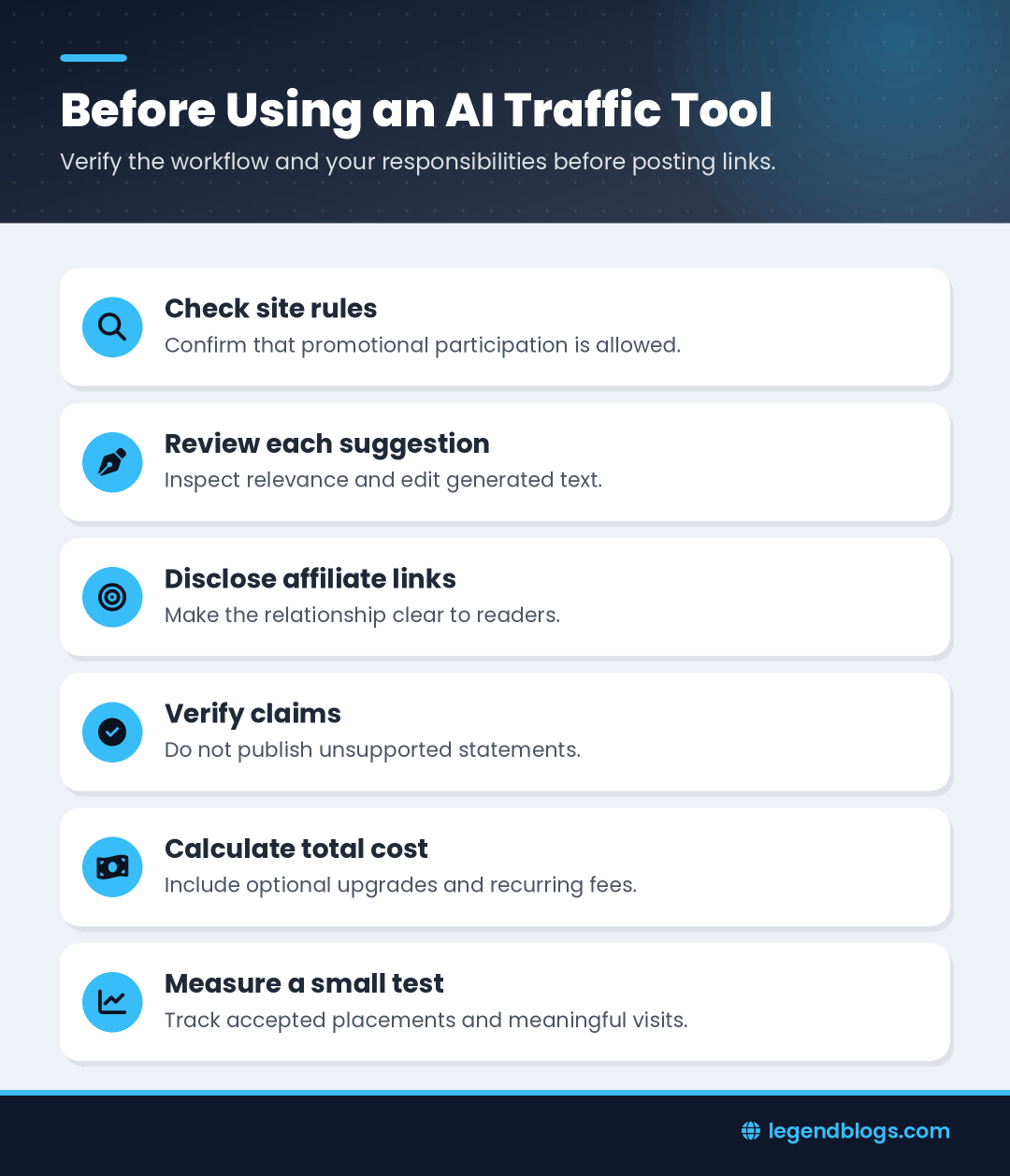
- Can I see a clear demonstration of the actual workflow?
- Can I inspect and edit every suggestion before using it?
- Do the target sites allow this type of promotion?
- What is my total cost, including optional upgrades and other services?
- What outcome can I measure without assuming a guaranteed result?
Make a decision based on your own use case
Cinepix AI may be worth considering only if the current product matches a specific research or drafting need and you can use it within the rules of the sites involved. A cautious buyer should verify the offer independently and start with a small, ethical test rather than making a large business plan depend on promotional claims.
If your priority is lasting audience growth, consider balancing any short-term experiment with useful content, a permission-based audience, and a clear measurement plan. The software should support a sound marketing process, not stand in for one.
Use the same standard when comparing any Cinepix AI review you find: verify the claims, weigh the costs, and decide whether the actual workflow suits your goals.
FAQ
Does Cinepix AI guarantee traffic or income?
No tool can establish a guaranteed result merely by generating suggestions. Traffic and income depend on whether placements are accepted, relevant people see them, and the offer and user experience convert.
Do I need a website to use Cinepix AI?
Its marketing has been described as not requiring users to build their own website for the advertised placement workflow. Confirm current requirements in the product documentation, and remember that not owning a site does not remove the need to follow placement rules.
Is Cinepix AI suitable for beginners?
A guided interface may be approachable, but beginners still need to understand relevance, affiliate disclosures, platform rules, and how to evaluate results. Do not assume that software knowledge alone is enough to run a responsible campaign.
What should I check before buying?
Confirm the included features, total checkout cost, recurring fees, upgrade terms, refund policy, privacy practices, and whether the tool's suggested workflow is allowed on the sites you intend to use. Treat earnings and traffic claims as claims to verify.
Can link placement violate a platform’s rules?
Yes. Each platform sets its own policies, and some restrict affiliate links, promotional replies, automation, or unsolicited content. Read the relevant rules and participate only where the placement is permitted and genuinely useful.
Final Thoughts
Cinepix AI is presented as a way to discover existing online pages and prepare promotional responses. The concept may appeal to marketers looking to streamline research, but suggestions alone do not establish accepted placements, qualified visitors, or commissions.
Before buying, verify the current offer and rules, calculate the complete cost, and decide what small test would give you useful evidence. If the workflow depends on irrelevant or unwanted links, or if the claims cannot be checked, skip it and invest in a more sustainable approach to reaching your audience.



Write a comment