
This Challenge Profits Fortune review examines the offer as a ready-made challenge platform, not as a promise of traffic or revenue. Its existing product description presents a challenge-based website experience with prepared content and monetization options. Those elements may be useful for some businesses, but their value depends on the current package, setup requirements, audience fit, and the work needed to attract and serve participants.
Challenge Profits Fortune Review: What Buyers Should Verify
Check the real deliverables and operating work
This Challenge Profits Fortune review separates the platform's advertised positioning from results that depend on the buyer, audience, and ongoing implementation.
Product pages and launch terms can change, and promotional language is not independent evidence of results. This guide separates the platform's stated features from outcomes a buyer should verify, and provides a practical way to assess total cost, implementation effort, and whether a challenge format fits your audience.
What Is Challenge Profits Fortune?
Product purpose and intended users
Challenge Profits Fortune is described as a done-for-you digital platform for running online challenges. The concept is to invite participants through a sequence of activities or milestones rather than send every visitor directly to a conventional sales page.
That format could be relevant to coaches, course creators, affiliates, or publishers who have a clear audience and a useful sequence to deliver. The product's intended positioning does not establish that participants will complete the challenge, return regularly, or purchase an offer.
For this Challenge Profits Fortune review, the intended use is only a starting point; verify the deliverables and workload that match your own business.
What needs verification
Before buying, confirm exactly what the current package includes. Check whether it provides a website, challenge lessons, participant accounts, progress tracking, hosting, installation help, updates, or a license—and whether any of these require separate services or additional purchases.
Do not assume that a screenshot or feature name explains how a system works in practice. Look for a current demonstration, written setup instructions, clear support terms, and details about what you can customize. These facts help distinguish a ready-to-use asset from a template that still requires substantial configuration.
How the Challenge-Based Model Works
The participant journey
A challenge usually asks a participant to complete a set of related actions over a defined sequence. A fitness coach might organize daily practice; a course creator might guide learners through preparation tasks; a business educator might offer a short skill-building program. The steps should help participants make progress, not exist merely to create repeated visits.
A clear journey explains what the participant will do, what materials are provided, how progress is recognized, and what happens after the final activity. If the offer is unclear or the tasks feel repetitive, participants may stop before reaching the intended outcome.
How an offer might fit
A paid product or affiliate recommendation can be relevant when it genuinely helps participants continue toward a goal. The recommendation should be introduced transparently, with an explanation of its role and any commercial relationship. It should not be disguised as a required challenge step when it is actually a sales offer.
Design the educational experience first. Decide what useful result the challenge can provide on its own, then consider whether an optional product or service is a natural next step. This helps protect trust and makes the program useful even to people who do not buy.
Features to Confirm
Website setup and included materials
The prior product description says the offer includes a challenge-oriented website structure and prepared content. If that remains part of the current offer, confirm whether the materials are editable, how installation works, what software or hosting is needed, and whether the site can be branded for your business.
Ask whether the included content is unique to your purchase or shared among many buyers, and what rights apply to modify or redistribute it. A ready-made starting point can save initial planning, but generic material may need substantial rewriting to fit your audience and accurately represent your expertise.
Customization, access, and support
Check how participants join, whether accounts or email addresses are collected, what progress features are available, and how the site behaves on mobile devices. Confirm whether you can adjust the challenge length, language, design, calls to action, and data collection settings.
Support and maintenance matter after launch. Verify the vendor's support channels and response expectations, updates policy, compatibility requirements, and any responsibilities you retain for backups, security, privacy notices, and troubleshooting. These ongoing tasks are part of the real effort, even when the initial setup is described as done for you.
Potential Uses for a Challenge Platform
Audience engagement and follow-up
A well-designed challenge can provide a reason for participants to return, especially when each step builds on the previous one and offers practical value. That is a design possibility, not a guarantee of higher retention. The audience must be interested, the tasks must be manageable, and communication must arrive at the right time.
Plan follow-up around the participant's progress. Useful reminders can clarify the next step or offer help, while repeated sales messages without meaningful support can undermine the experience. If the platform collects contact details, explain what people are signing up for and how their information will be used.
Coaches, creators, and affiliates
Coaches may use a challenge to help prospects experience a small part of a method before considering a paid service. Course creators can use a short sequence to orient learners or help them prepare for a larger program. Affiliates may include a relevant product recommendation when it supports the learning goal and is disclosed appropriately.
These uses still require audience research, content planning, and a clear next step. A challenge platform does not create demand on its own. It gives you a format for delivering an experience; you remain responsible for making that experience worthwhile and reaching the right people.
Limitations and Risks
Traffic and conversion are not guaranteed
A website or challenge does not automatically attract visitors. You need a legitimate traffic plan, such as an existing audience, useful search content, partnerships, or paid promotion that fits your budget and complies with relevant rules. Each channel requires its own work and measurement.
Even if people join, they may not finish the sequence or respond to offers. Outcomes depend on the audience's needs, the clarity of the promise, the quality of the challenge, the follow-up, and the offer itself. Treat claims about easy or automatic results as claims to investigate, not as a dependable forecast.
Content, platform, and maintenance responsibilities
Preloaded material can speed up setup, but it may not reflect your voice, current information, or the promises you are qualified to make. Review every lesson and claim. Replace generic examples with material that is accurate, useful, and appropriate for your audience.
You may also depend on WordPress, hosting, plugins, email services, or other providers. Confirm what is included and who handles updates or support. Keep backups, secure administrative access, and use an appropriate privacy approach for any participant information you collect. A platform purchase does not remove these operational responsibilities.
Pricing, Bonuses, and Total Cost
Confirm current terms at checkout
The old launch description may not reflect the current offer. Check the current price, currency, taxes, billing frequency, refund terms, access period, and the exact deliverables before paying. If a bonus is promoted, verify what it is, whether it is included automatically, and whether it has any separate conditions.
Look for optional upgrades, recurring hosting or software costs, paid plugins, support plans, and services needed to run the challenge. Calculate a realistic total for the first year or the period you plan to use it, rather than comparing only the initial purchase price.
Assess additional costs and upgrades
Some buyers may need a domain, hosting, email delivery, design work, or professional help with setup. These costs vary by business and provider, so do not assume they are included or estimate them from a promotional page without checking the actual requirements.
For each upgrade, ask whether it solves a current problem. If the base package is enough to test whether your audience responds to a challenge, delay optional add-ons until you have evidence of need. Bonuses can be useful, but they should not distract from the core product's terms or fit.
Who Might Consider It?
Potential fit
The offer may be worth investigating for someone who already has a defined audience, a sequence of useful activities, and a reason to deliver them through an interactive experience. A buyer with WordPress familiarity or access to technical support may be better prepared to handle configuration and maintenance.
Before proceeding, outline the challenge in your own words: who it serves, what participants will do, what progress looks like, and what optional next step makes sense. If those answers are clear, you can compare the product's current functions with a genuine business need.

When a simpler approach may be better
A challenge platform may be unnecessary if your audience needs a short guide, a simple email sequence, or a straightforward booking page. A more elaborate system can add setup and upkeep without improving the participant experience.
That trade-off is an important part of this Challenge Profits Fortune review: a ready-made system is valuable only when its added structure serves the participant.
It may also be a poor fit if you have no plan to reach participants, do not want to update supplied content, or expect the software to generate revenue on its own. Start with the simplest format that delivers the result your audience needs, then add complexity only when it solves a demonstrated problem.
Challenge Platform vs. a Traditional Funnel
Differences in user journey and maintenance
A traditional funnel often directs visitors through a sequence of pages and messages toward a decision. A challenge adds activities or milestones that participants complete over time. The challenge format may create more opportunities to teach and interact, but it also requires content, scheduling, support, and follow-up.
Neither format is automatically superior. A concise offer may be clearer through a simple page, while a skill or behavior that benefits from guided practice may be better delivered as a sequence. Choose based on what helps the visitor, not on broad claims that one format always converts better.
How to choose for your goal
Map the experience from first visit to completion. Identify what each step contributes, what information you need to collect, and how you will know whether participants are benefiting. If you cannot explain why a user must return, a challenge may add friction rather than value.
Compare the platform with a lightweight version you could build using existing tools. Consider setup time, ongoing maintenance, accessibility, data handling, and the ability to change the experience. The best option is the one you can operate consistently while meeting the audience's needs.
How to Evaluate It Before Buying
Product and vendor checklist
Use the current product page and written terms to verify the basics. Make sure the demonstration matches what you will receive, and confirm the installation steps, licensing, included content, support, refund policy, and any technical requirements.
Questions to answer before checkout include:
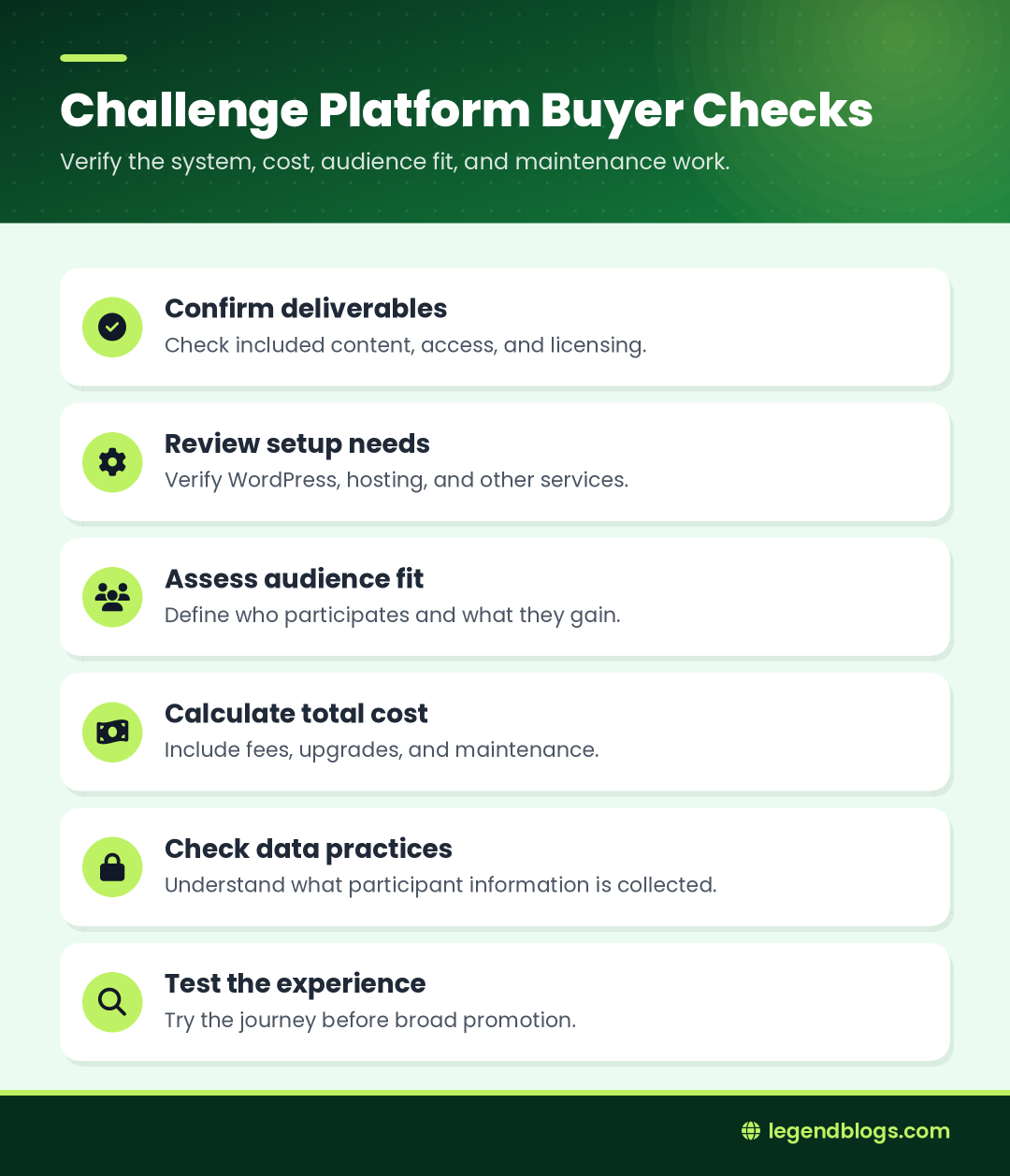
- What exactly is included in the current purchase?
- Does it require WordPress, hosting, or paid services?
- Can the content, design, and participant journey be customized?
- What are the support, update, and refund terms?
- Are there optional upgrades or recurring fees?
- How will participant data be collected, stored, and protected?
Run a small test and define success
If possible, test the experience with a small group before promoting it broadly. Ask whether the instructions are clear, the activities are useful, and the platform works on the devices people use. Note where participants hesitate or drop out, then improve those steps.
Choose measures that fit your goal, such as completion, useful feedback, or sign-ups from people who explicitly want follow-up. Do not treat a high number of page views as proof of business value. Track the experience honestly and avoid promising results that your test cannot support.
Is Challenge Profits Fortune Worth It?
A cautious decision framework
Challenge Profits Fortune may be worth considering if its current package includes the specific website structure and materials you need, the setup requirements are manageable, and a challenge format serves your audience better than a simpler alternative. Its value depends on the actual deliverables and your ability to implement and maintain them.
It is not a traffic source or income guarantee by itself. If your plan depends on unverified claims of automatic engagement, viral sharing, or easy monetization, pause and request evidence. A platform can support a business process, but it cannot substitute for a useful experience and a plan to reach participants.
Final buyer considerations
Before purchasing, compare the total cost and setup effort with building a small test using tools you already have. Check the terms, inspect the content, and identify the ongoing tasks you will own. If the platform fits a specific need and you can measure the test responsibly, you can make a more informed decision.
If the product's current details are unclear, wait until you can verify them. A careful purchase decision protects both your budget and your audience's trust.
A balanced Challenge Profits Fortune review should leave you with a clear test plan and realistic expectations, not a promise of guaranteed business results.
FAQ
Is Challenge Profits Fortune beginner-friendly?
The offer is described as a ready-made setup, which may reduce some initial technical work. Beginners should still verify the installation requirements, learn how to maintain the site, and understand the marketing and privacy responsibilities involved.
Does it guarantee traffic or income?
No. A challenge website does not guarantee visitors, completions, conversions, or earnings. Results depend on the audience, content, promotion, offer, and execution.
Do I need WordPress?
The earlier product description presented the platform as WordPress-based. Confirm the current technical requirements and what hosting, plugins, or other services you need before buying.
What costs should I check before buying?
Verify the current purchase price, taxes, recurring fees, upgrades, hosting, domain, plugins, email services, and any setup help you may need. Read the refund and access terms as well.
Can I use a challenge platform in any niche?
A challenge can be adapted to different subjects, but suitability depends on whether participants benefit from a sequence of activities. Choose a topic where you can provide accurate, useful guidance and make any commercial relationships clear.
Final Thoughts
Challenge Profits Fortune is positioned as a ready-made way to deliver a challenge-based online experience. That format can be worth exploring when it matches a real audience need, but supplied content and software alone do not guarantee participation or sales.
Verify the current package, costs, setup requirements, and ongoing responsibilities before buying. Decide what you want participants to achieve and test whether the platform supports that outcome. If a simpler format would serve them just as well, choose the simpler option.


Write a comment