
AI side hustles attract attention because software can help with research, drafting, design, and repetitive work. But a tool does not create a customer or guarantee income. A workable online offer still needs a specific audience, a problem worth solving, reliable delivery, and honest expectations.
This guide looks at practical AI side hustles that can be presented and sold through a website: content support, carefully edited digital products, small website services, and research or workflow assistance. The goal is to help you choose a manageable experiment, not to promise a particular return.
Start with work you can evaluate yourself. If you cannot recognise a mistake in the output, you may not be ready to sell it as a finished service. Human judgement, subject knowledge, and clear communication are what turn automated assistance into something customers can trust.
1. What counts as an AI side hustle
1.1 Sell a useful outcome, not just a tool
A customer usually wants a result: a clearer product page, a set of organised research notes, a functioning landing page, or a learning resource that saves time. They are not necessarily looking to buy your access to an AI tool. Describe what you will deliver, who it is for, what is included, and what remains outside the scope.
AI may help you produce a first draft or automate a routine step, but your offer should explain the human work around it. That could include checking facts, tailoring the material, formatting the deliverable, or helping the client implement it.
1.2 Separate an experiment from a business
A side project can begin as a small test: offer one service to a narrowly defined audience, talk to potential buyers, and see whether they understand its value. Do not treat a few encouraging comments as proof of stable demand. A repeatable business needs a way to find customers, fulfil work, and account for expenses and time.
Keep a simple record of inquiries, completed work, revisions, direct costs, and hours. This helps you judge whether an idea is practical, even if revenue is irregular at first. Avoid borrowing heavily or making commitments based on an untested concept.
2. Choose a problem people will pay to solve
2.1 Look for a specific audience
Start where you already understand the work. A tutor may know what lesson materials take time to prepare; a local shop owner may notice product information that is difficult to maintain; a developer may know how small teams struggle to document a website. Familiarity helps you ask better questions and recognise poor output.
Describe the audience in a way that changes the offer. “Small businesses” is broad. A specific group—such as independent repair shops that need clearer service pages—gives you a more focused problem to investigate and a more useful example to show.
2.2 Validate interest before building
Speak with potential customers, review competing offers, and ask what they currently do when the problem appears. Find out how often it happens, what is frustrating about existing approaches, and what a successful result would look like. The U.S. Small Business Administration’s planning guidance recommends using market research to understand demand, customer characteristics, competition, and pricing.
Use a basic landing page or a short service description to explain a proposed offer, but do not imply that the service is established if it is not. A few direct conversations can reveal that people need a different solution—or that the issue is not important enough to pay for.

3. Offer a website content service
3.1 Define a clear scope and review process
You could offer a content refresh for a limited set of pages, such as rewriting product descriptions from verified client notes or organising an FAQ from support questions. Specify how many pages are included, what information the client must provide, how many review rounds are included, and what is delivered in the final format.
Use AI to assist with outlining or variation, then fact-check every claim and edit for voice, originality, and usefulness. Ask the client to approve technical, legal, and product-specific statements. Never invent customer reviews, credentials, performance claims, or product features to make copy sound more convincing.
3.2 Show sample work responsibly
Create a clearly labelled sample using your own fictional business or material you have permission to use. Explain the problem and the editing decisions, not just the tool. If you show a before-and-after example from a client, get written permission and remove private information.
Sell a defined deliverable rather than unlimited “AI content.” A small package could include a content brief, edited page copy, and a handoff note listing assumptions to confirm. Clear boundaries protect both you and the customer from mismatched expectations.
4. Create digital products with AI assistance
4.1 Choose a focused resource
Digital products can include checklists, planning templates, worksheets, or short reference guides. Start with a recurring task you understand and make the resource help someone complete that task. A narrowly useful template is often easier to test than a large bundle built without audience feedback.
Use AI for brainstorming, outlining, or formatting ideas, but verify the material and make the finished resource genuinely your own. Check that examples are accurate, instructions are complete, and the product solves a coherent problem. An attractive PDF with vague advice does not become valuable because it was produced quickly.
4.2 Add review, support, and clear terms
Explain what the download includes, what tools are needed to use it, whether updates are provided, and how buyers can contact you if a file is broken. Be clear about permitted use and any restrictions. Do not copy protected material or use a third party’s branding in a way that implies endorsement.
Test the purchase and download flow from a customer’s perspective. Check payment confirmation, file access, mobile readability, and the support route. Keep a backup of the files and a process for correcting errors.
5. Build a small website or landing-page service
5.1 Offer a narrow, deliverable package
AI-assisted site builders can help assemble page drafts, but customers still need a site that reflects their business accurately. A focused service might prepare a one-page event site, a simple portfolio, or a first draft for a local service business. State exactly what is included: page count, content inputs, revisions, domain setup, and maintenance.
Use an intake checklist to collect approved names, service details, images, contact information, and desired actions. Do not allow a builder to invent testimonials, guarantees, opening hours, or legal statements. Get permission for images and logos, and confirm that the final site belongs to the client as agreed.
5.2 Clarify revisions and ongoing support
Set a revision process before work begins. Distinguish between correcting an error, changing supplied facts, and adding a new section. Explain whether post-launch edits, hosting, backups, accessibility checks, or analytics configuration are part of the package or separate work.
Test the completed pages on multiple screen sizes and verify links, forms, and contact routes. Keep a handoff document with access instructions and a list of client responsibilities, without storing passwords in ordinary documents or email.
6. Provide research or workflow support
6.1 Make the service transparent
Some clients need help organising public information, preparing an initial research brief, or documenting repetitive processes. AI can assist with sorting and summarising, while you check sources and label uncertainty. Make clear whether the deliverable is a starting point or a verified analysis.
For research, preserve source links and separate direct observations from interpretations. Do not present generated summaries as original research or pass off a guess as a fact. If the subject requires specialised expertise, refer the client to a qualified professional rather than overselling your competence.
6.2 Protect client information
Agree on what information the service needs and where it may be processed. Avoid sending confidential client data to an external AI service unless the client has approved the arrangement and the relevant safeguards are in place. Remove unnecessary identifiers from working examples and control access to files.
Set a retention plan: know where working documents are stored, who can access them, and when they should be removed. A simple written process builds confidence and reduces the chance of accidentally reusing a client’s private material.
7. Set up a simple website to find customers
7.1 Explain the offer and show proof of work
Your own website should answer four questions quickly: who you help, what you deliver, how the process works, and how to start a conversation. Use specific examples and a clear contact option. If you are new, show a labelled sample rather than implying a client history you do not have.
Keep the site focused. A home page, service details, a short about section, and contact information may be enough to begin. Make sure the site works on phones, forms reach the right inbox, and visitors can understand what happens after they submit a request.
7.2 Make the next step easy
Offer a low-friction next step that suits the service, such as requesting a short discovery call or sharing a project brief. Explain what information you need and when the person can expect a response, if you can honour that commitment. Avoid collecting data just because a form builder makes it available.
Use clear privacy information and secure account practices. Review your website’s contact and analytics tools, and keep business and personal records organised. A small online presence should be trustworthy before it is elaborate.
8. Price, test, and manage the work
8.1 Start with a manageable scope
Estimate the time needed for intake, drafting, checking, revisions, delivery, and support—not only the minutes spent using an AI tool. Include software costs, payment fees, taxes, and time spent finding customers when evaluating whether the offer is sustainable. Do not set a price based solely on what a competitor advertises without understanding what their service includes.
For early projects, use a written scope and an agreed payment process. Explain what triggers extra work and how either side can pause. Keep records of income and expenses and seek qualified local advice on tax or business obligations when necessary.
8.2 Track feedback and improve the offer
After delivery, ask whether the customer could use the result, what was unclear, and what they would change. Look for patterns across projects instead of rebuilding the offer after one opinion. If customers repeatedly need a step you did not include, decide whether to adjust the package or state that boundary more clearly.
Measure the work in practical terms: enquiries that fit the audience, completed deliveries, revision load, repeat interest, and time required. These signals can guide your next decision, but they do not guarantee future results.
9. Avoid common risks and misleading claims
9.1 Check rights, accuracy, and disclosure needs
Review the terms of tools and platforms you use, and confirm that you can use the resulting material for your intended purpose. Do not upload client content without permission. Check facts and sources, particularly when outputs concern money, health, law, or safety.
Be transparent about what the customer is buying and what work was automated where that is relevant to the relationship or required by applicable rules. Do not claim guaranteed income, instant success, or effortless results. Marketing should describe a real service, its limits, and the evidence you can support.
9.2 Do not confuse attention with demand
A viral post or a crowded discussion may show that people are curious, not that they will pay for your offer. Talk with the specific audience, compare existing options, and test a small service before investing in a large product or advertising campaign. The SBA’s market research framework is a useful reminder to check demand, competition, and pricing rather than relying on assumptions.
Choose an idea you can deliver responsibly, even if it grows slowly. If a workflow depends on copying others’ work, hiding limitations, or making claims you cannot prove, redesign the offer. A small, honest service is a stronger starting point than a shortcut that damages trust.
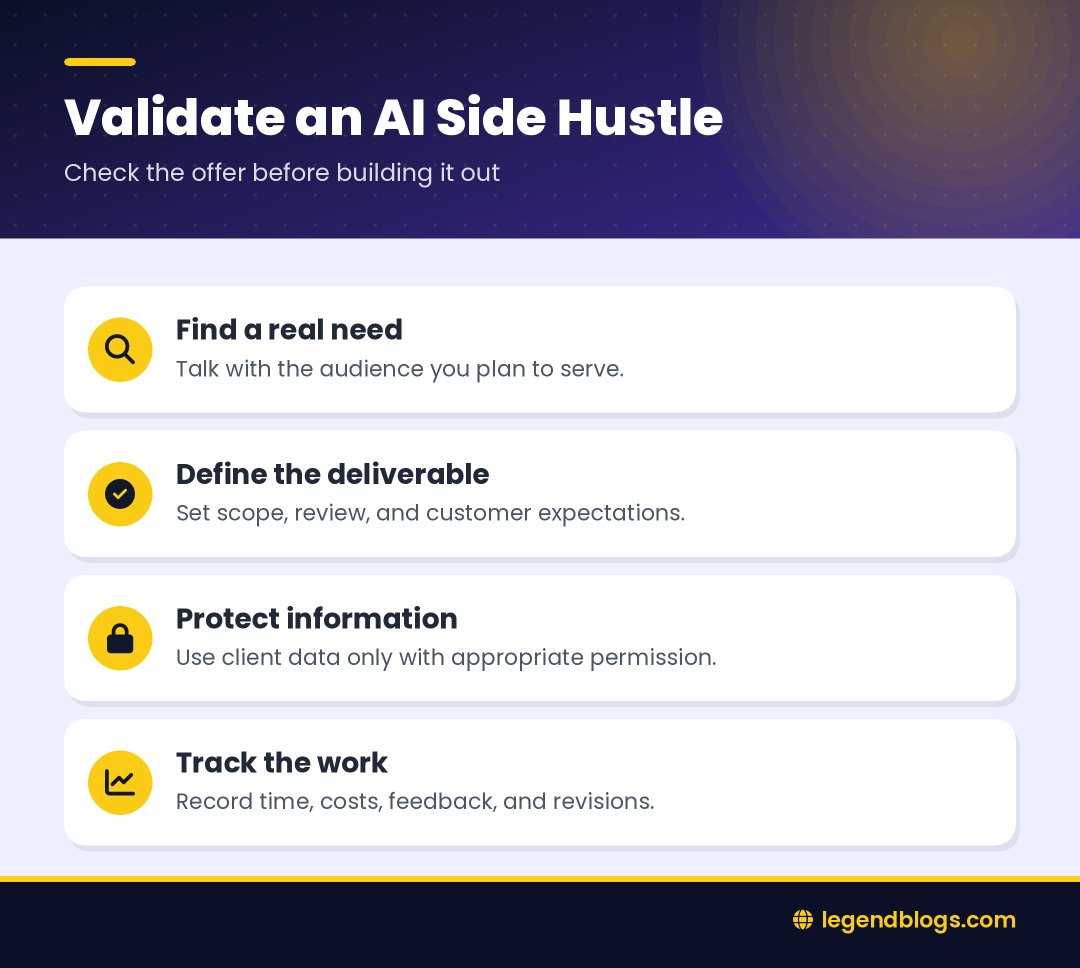
AI Side Hustles: A Quick Validation Checklist
Check the need before investing
Before expanding AI side hustles into a larger business, confirm that the intended audience experiences the problem and can explain how they handle it now. Review competing offers, ask what is missing, and test a small clearly scoped service. Useful validation is evidence of a real next step, not simply a compliment or a view count.
Check that delivery is repeatable
For AI side hustles, also record the time spent on customer conversations, review, revisions, delivery, and support. If the offer only works when you skip fact-checking or ignore privacy, revise the process before scaling. A repeatable, honest service is a stronger signal than a fast first draft.
FAQ
Can you make money online with AI without coding?
Yes, some services rely more on writing, design, research, or organisation than on programming. You still need a useful skill, a defined customer problem, quality checks, and a way to deliver the result reliably.
Which AI side hustle is suitable for beginners?
Choose a small service related to something you already understand, such as editing supplied website copy or organising a simple workflow. Start with a limited scope and validate interest before building a large product.
How can I check whether an online idea has demand?
Talk to potential customers, study competing offers, ask how they handle the problem today, and test a clearly described offer. Look for real willingness to take a next step rather than relying only on compliments or online attention.
Do AI-generated products need human review?
Yes. Review facts, originality, usability, rights, and the quality of instructions. Customers are paying for a product they can use, not simply for an automated first draft.
Can an AI side hustle guarantee a specific income?
No. Income depends on factors such as demand, costs, skill, pricing, and consistent delivery. Avoid promises of guaranteed earnings and test the business carefully.
Conclusion
AI side hustles are best approached as ordinary small businesses with a new set of tools, not as automatic income machines. Find a narrow problem, validate it with potential customers, and design a deliverable that combines automation with your own judgement and care.
Start with one modest offer and a clear website page. Track the time and costs, protect customer information, and improve the service using feedback. If the offer is useful and repeatable, you will have a sound basis for deciding whether to grow it further.
If you are exploring ways to make money online, compare different online income approaches against the time, skills, costs, and customer support they require. The IRS Gig Economy Tax Center explains that income from gig work may have tax-reporting obligations; check the rules that apply to your location and situation.




Write a comment