The following are frequently asked Laravel and PHP related interview questions for freshers as well as experienced candidates to get the right job. A list of top frequently asked Laravel Interview Questions and answers are given below.
How to Prepare for Laravel Interview Questions
Connect concepts to practical work
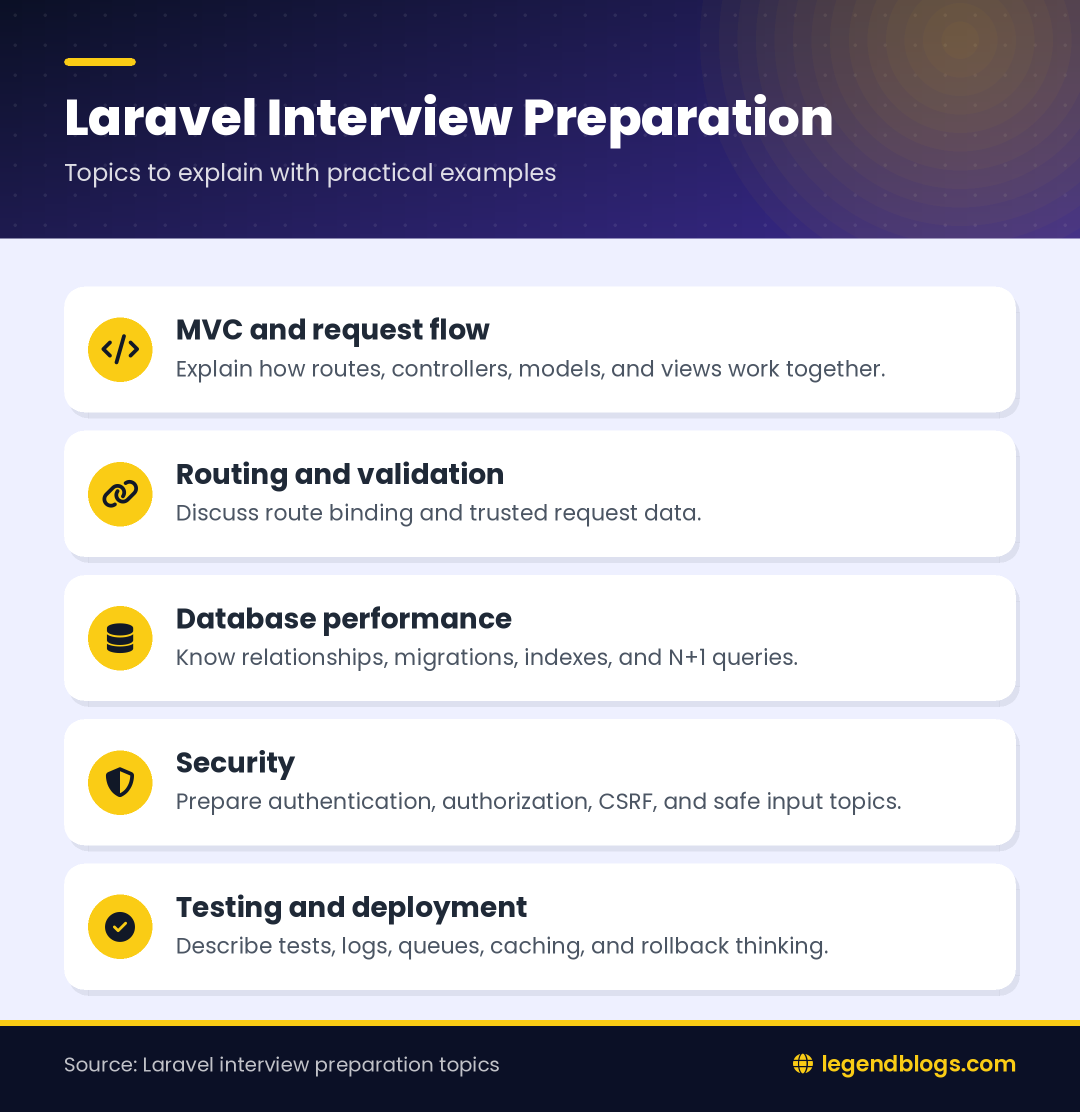
Do not memorise definitions without context. For each topic, practise explaining what it does, why a team uses it, and one trade-off or failure case. A strong answer connects a route to a controller, validation to trusted input, a model to a relationship, and authorization to the user action being protected.
Use a clear answer structure
Start with a short definition, give a small example, and finish with a reason the feature matters. Mention the Laravel version when syntax may differ. If you would verify a detail in the documentation, say so instead of guessing.
Application Structure and MVC
How does MVC work in Laravel?
Models represent application data, views present information, and controllers coordinate requests and responses. Laravel applications also use routes, middleware, service providers, requests, jobs, events, and policies. The structure gives each responsibility a clearer home instead of placing every operation in one large file.
What makes a project maintainable?
Readable names, small methods, validation at the request boundary, consistent error handling, automated tests, and clear migrations all help maintainability. If a controller contains queries, formatting, notifications, and authorization together, explain how you would separate those concerns carefully.
Routing, Validation, and Eloquent
What is route model binding?
Route model binding allows Laravel to resolve a route parameter into a model before the controller method runs. It reduces repeated lookup code and can provide a consistent not-found response. Explain that the route parameter and model relationship must be configured consistently.
How should Eloquent queries be designed?
Select the data the screen needs and consider filtering, pagination, indexes, and relationships. Be aware of the N+1 query problem, which can happen when related records are loaded one at a time. Eager loading can help when related data is genuinely required, but loading everything by default can waste memory.

Authentication, Authorization, and Security
What is the difference between authentication and authorization?
Authentication identifies the user. Authorization decides whether that user may perform a particular action on a resource. Laravel applications can express authorization with gates or policies, and the server must enforce the decision even when the interface hides an unavailable button.
Which security topics should you prepare?
Know the purpose of CSRF protection, password hashing, input validation, mass-assignment protection, secure file handling, output escaping, dependency updates, and access control. Framework defaults help, but application configuration and operational practices still matter.
Queues, Caching, and Testing
When should a task use a queue?
Queues suit work that does not need to delay the user's response, such as sending mail, processing a large file, or generating a report. Discuss retries, failure handling, idempotency, and monitoring. A queued task should be designed so that a retry does not create unintended duplicate work.
How do you investigate a slow page?
Measure the request duration, database queries, query count, external services, cache behaviour, and payload size before changing code. Possible improvements include indexes, pagination, eager loading, caching, or moving non-essential work to a queue. Tests should cover important success and failure paths.
Scenario-Based Interview Questions
How would you handle a failed deployment?
Check deployment and application logs, environment configuration, migration state, cache state, permissions, queue workers, and health checks. Protect user data first and follow the project's rollback process rather than making untracked production changes.
What mistakes should candidates avoid?
- Giving a definition without explaining when a feature is useful.
- Confusing authentication with authorization.
- Ignoring validation and security when describing a controller.
- Suggesting caching without discussing stale data and invalidation.
- Using outdated syntax without naming the Laravel version.
FAQ
Is Laravel difficult to learn?
Laravel is approachable when you understand PHP, HTTP, databases, and object-oriented programming. Learn the request lifecycle and core conventions before adding advanced packages.
What is the difference between Laravel and PHP?
PHP is the programming language. Laravel is a framework for PHP that provides conventions and tools for routing, views, databases, validation, authentication, queues, and testing.
What is Laravel middleware?
Middleware filters or processes HTTP requests and responses. Common uses include authentication, throttling, logging, and maintenance checks.
What is Eloquent ORM?
Eloquent is Laravel's model and object-relational mapping layer. It lets developers work with database records through models and relationships while retaining lower-level query options when needed.
Which Laravel topics should beginners study first?
Start with PHP fundamentals, routing, controllers, views, migrations, Eloquent, validation, authentication, middleware, testing, and Artisan. Build a small project so each topic connects to a working request.
Conclusion
Effective Laravel preparation combines accurate definitions with practical judgement. Practise explaining the request lifecycle, data validation, authorization, database performance, testing, and deployment using small examples.
Review these Laravel interview questions aloud and identify the areas where your explanation becomes vague. Then build or inspect a small application and use the experience to make your answers more specific.
Laravel is a PHP web framework launched by Taylor Otwell. It is a free and open-source framework that is designed to develop web applications with MVC (Model-View-Controller).
Stay tuned for the latest advancements and best Laravel Interview Questions. It is based on Symfony and its source is GitHub licensed under MIT license terms. Released in the year 2011, it is featured as a modular packaging system.
Laravel in few lines
- Source code hosted on GitHub and licensed under MIT License.
- Most Starred PHP Framework for custom software development on Github.
- Its ability to use all of the new features of PHP sets it apart.
- Web applications with MVC (Model-View-Controller).
- Friendly online community
- Detailed documentation
Laravel Interview Questions and Answers
1. What is Laravel?
Laravel is free to use, open-source web framework based on PHP. It is developed by Taylor Otwell . It supports the MVC (Model-View-Controller) architectural pattern.
2. What are some benefits of Laravel over other Php frameworks?
- The setup and customization process is easy and fast as compared to others.
- Inbuilt Authentication System
- Supports multiple file systems
- Pre-loaded packages like Laravel Socialite, Laravel cashier, Laravel elixir, Passport, Laravel Scout
- Eloquent ORM (Object Relation Mapping) with PHP active record implementation
- Built-in command line tool “Artisan” for creating a code skeleton, database structure and build their migration
3. What are the main features of Laravel?
Some of the main features of Laravel are:
- Eloquent ORM
- Migrations
- Query builder
- Reverse Routing
- Restful Controllers
- Database Seeding
- Unit Testing
- Homestead
4. What is HTTP middleware?
HTTP middleware is a technique for filtering HTTP requests. Laravel includes a middleware that checks whether application user is authenticated or not.
5. Explain Migrations in Laravel
Laravel Migrations are like version control for the database, allowing a team to easily modify and share the application’s database schema. Migrations are typically paired with Laravel’s schema builder to easily build the application’s database schema.
6. What do you understand by Eloquent ORM?
Eloquent ORM (Object-Relational Mapping) is one of the main features of the Laravel framework. It may be defined as an advanced PHP implementation of the active record pattern.
7. What is PHP artisan? List out some artisan commands ?
PHP artisan is the command line interface/tool included with Laravel. It provides a number of helpful commands that can help you while you build your application easily. Here is the list of some artisan command:-
- PHP artisan list
- PHP artisan help
- PHP artisan tinker
- PHP artisan make
- PHP artisan –version
- PHP artisan make model model_name
- PHP artisan make controller controller_name
8. What is a Route?
A route is basically an endpoint specified by a URI (Uniform Resource Identifier). It acts as a pointer in Laravel application. Most commonly, a route simply points to a method on a controller and also dictates which HTTP methods are able to hit that URI.
9. Why use Route?
Routes are stored inside files under the /routes folder inside the project's root directory. By default, there are a few different files corresponding to the different "sides" of the application ("sides" that comes from the hexagonal architecture methodology).
10. What are Facades?
Facades provide a “static” interface to classes that are available in the application’s service container.
11. Where Laravel’s facades are defined?
All of Laravel’s facades are defined in the Illuminate\Support\Facades namespace.
12. What do you mean by bundles?
In Laravel, bundles are referred to as packages. These packages are used to increase the functionality of Laravel. A package can have views, configuration, migrations, routes, and tasks.
13. Does Laravel support caching?
Yes, Laravel provides support for popular caching backends like Memcached and Redis. By default, Laravel is configured to use file cache driver, which is used to store the serialized or cached objects in the file system. For huge projects, it is suggested to use Memcached or Redis.
14. How will you explain middleware in Laravel?
As the name suggests, middleware works as a middleman between request and response. Middleware is a form of HTTP request filtering mechanism. For example, Laravel consists of middleware which verifies whether the user of the application is authenticated or not.
If a user is authenticated and trying to access the dashboard then, the middleware will redirect that user to the home page; otherwise, a user will be redirected to the login page.
There are two types of middleware available in Laravel:
Global Middleware
It will run on every HTTP request of the application.
Route Middleware
It will be assigned to a specific route.
15. What is reverse routing in Laravel?
In Laravel reverse routing is generating URLs based on route declarations. Reverse routing makes your application so much more flexible. For example, the below route declaration tells Laravel to execute the action “login” in the user's controller when the request’s URI is ‘login’.
http://example.com/login
Route::get(‘login’, ‘users@login’);Using reverse routing we can create a link to it and pass in any parameters that we have defined. Optional parameters, if not supplied, are removed from the generated link.
{{ HTML::link_to_action('users@login') }}It will create a link like http:// example .com/login in view.
16. What do you understand by Unit testing?
Unit testing is built-in testing provided as an integral part of Laravel. It consists of unit tests which detect and prevent regressions in the framework. Unit tests can be run through the available artisan command-line utility.
17. What is a Controller?
A controller is the "C" in the "MVC" (Model-View-Controller) architecture, which is what Laravel is based on.
18. How will you register service providers?
You can register service providers in the config/app.php configuration file that contains an array where you can mention the service provider class name.
19. What is CSRF Protection?
Laravel makes it easy to protect your application from cross-site request forgery (CSRF) attacks. Cross-site request forgeries are a type of malicious exploit whereby unauthorized commands are performed on behalf of an authenticated user.
20. What is View Routes?
If your route only needs to return a view, you may use the Route:: view method. The view method accepts a URI as its first argument and a view name as its second argument. In addition, you may provide an array of data to pass to the view as an optional third argument.
Route::view(‘/welcome’, ‘welcome’);
Route::view(‘/welcome’, ‘welcome’, [‘name’ => ‘Taylor’]);




Write a comment